Speaker
Description
Ya. D. Krivenko-Emetov$^{1,2,3,*}$ and B. I. Sydorenko$^{2,\dagger}$
$^{1}$National Technical University of Ukraine "Igor Sikorsky Kyiv Polytechnic Institute", Kyiv, Ukraine;$^{2}$Institute for Nuclear Research, National Academy of Sciences of Ukraine, Kyiv, Ukraine;$^{3}$Taras Shevchenko National University of Kyiv, Kyiv, Ukraine$^{*}$y.kryvenko-emetov@kpi.ua; $^{\dagger}$former member of KINR NASU
Inclusive zero-angle deuteron breakup probes the deuteron wave function and the short-distance reaction mechanism. We present a unified Glauber--Sitenko multiple-diffraction description of the $H(d,p)X$ and $^{12}C(d,p)X$ spectra. The formulation develops the diffraction approach used in our work with A. P. Kobushkin [1] and continues the MSDT treatment of few-nucleon-cluster breakup, including diffractive triton dissociation by incident protons [2]. In addition to the longitudinal transfer $Q_z$, we explicitly retain a nonzero transverse relative momentum of the final $pn$ pair in the antilaboratory system: $k_{\perp}=p_{\perp}-Q_{\perp}/2\ne0$, while $k_z=p_3^{*}$.
For $H(d,p)X$, retaining small $Q_z$ and transverse relative momentum changes the height and position of the quasifree maximum. Calculations with the multigaussian K2, AV18, and Nijm-I wave functions show that this refinement is essential for quantitative comparison with the spectrum and provides a controlled nucleonic baseline at large $|k_z|$ [3].
For $^{12}C(d,p)X$, the same kinematics is supplemented by the proton--nucleus electromagnetic interaction, Coulomb--nuclear interference, and the Coulomb correction to double $pn$ rescattering [4]. An analytical Coulomb phase is obtained for a finite charge distribution, with its scale fixed by the measured $^{12}$C charge radius. To first order in the Sommerfeld parameter,
$$F_{\rm tot}=F_{\rm str}+\Delta F_{Cp}+\Delta F_{Cpn}+O(\eta^2),$$
where $\Delta F_{Cp}$ corrects the proton line and $\Delta F_{Cpn}$ corrects double $pn$ rescattering. Thus Coulomb--nuclear interference is retained, and the two-dimensional rescattering term is reduced to a one-dimensional radial integral, extending earlier Coulomb treatments of $A(d,p)X$ breakup [1].
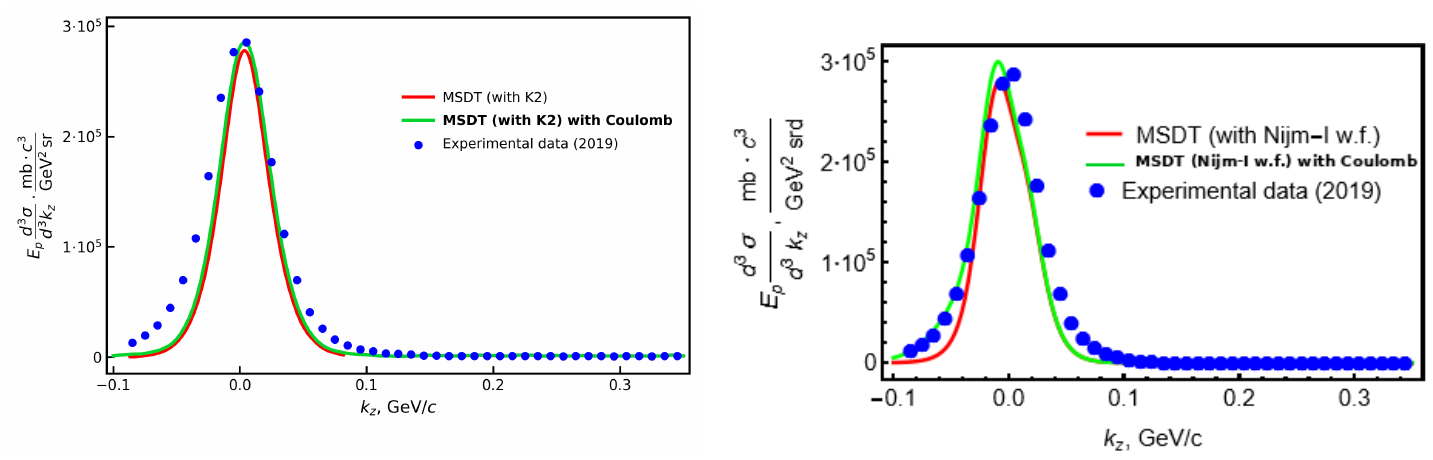 **Figure 1.** Results for $^{12}C(d,p)X$. Left panel: K2 wave function with $\sigma_{pN}=390$ mb, $\beta_p=1.22$ fm$^{-1}$, $\mu=0.25$ fm, $a=1$, $k_x=10^{-4}$ GeV/$c$, and $Q_z=-2.5\times10^{-3}$ GeV/$c$. Right panel: Nijm-I wave function with $\sigma_{pN}=350$ mb, $\rho_{pN}=10^{-4}$, $p_d=9.1$ GeV/$c$, $\beta_p=2.19$ fm, $\mu=10^{-6}$, $a=\alpha_L=1$, $k_x=-0.26$ GeV/$c$, $k_y=0$, and $Q_z=-2.5\times10^{-3}$ GeV/$c$. The calculated grid is $-0.10\leq k_z\leq0.25$ GeV/$c$ with $\Delta k_z=0.0125$ GeV/$c$. Therefore, $k_\perp=0.26$ GeV/$c$ and is nonzero in the antilaboratory system. Red curve: strong MSDT; green curve: MSDT with Coulomb; blue points: 2019 data [5].
Both the K2 and Nijm-I calculations show that Coulomb--nuclear interference increases the narrow quasifree peak and improves its normalization, while becoming small at $0.3$--$0.5$ GeV/$c$. Thus, $Q_z$ and $k_\perp$ govern the kinematic displacement and broadening, whereas the finite-size Coulomb interaction mainly renormalizes the low-momentum peak. This provides a baseline for final-state interactions and for relativistic refinements not included here: invariant flux and phase-space Jacobians; Lorentz boosts between the antilaboratory and final-$pn$ center-of-mass frames; a covariant or light-front deuteron wave function with spin rotations; D-wave and nonnucleonic components.
**Figure 1.** Results for $^{12}C(d,p)X$. Left panel: K2 wave function with $\sigma_{pN}=390$ mb, $\beta_p=1.22$ fm$^{-1}$, $\mu=0.25$ fm, $a=1$, $k_x=10^{-4}$ GeV/$c$, and $Q_z=-2.5\times10^{-3}$ GeV/$c$. Right panel: Nijm-I wave function with $\sigma_{pN}=350$ mb, $\rho_{pN}=10^{-4}$, $p_d=9.1$ GeV/$c$, $\beta_p=2.19$ fm, $\mu=10^{-6}$, $a=\alpha_L=1$, $k_x=-0.26$ GeV/$c$, $k_y=0$, and $Q_z=-2.5\times10^{-3}$ GeV/$c$. The calculated grid is $-0.10\leq k_z\leq0.25$ GeV/$c$ with $\Delta k_z=0.0125$ GeV/$c$. Therefore, $k_\perp=0.26$ GeV/$c$ and is nonzero in the antilaboratory system. Red curve: strong MSDT; green curve: MSDT with Coulomb; blue points: 2019 data [5].
Both the K2 and Nijm-I calculations show that Coulomb--nuclear interference increases the narrow quasifree peak and improves its normalization, while becoming small at $0.3$--$0.5$ GeV/$c$. Thus, $Q_z$ and $k_\perp$ govern the kinematic displacement and broadening, whereas the finite-size Coulomb interaction mainly renormalizes the low-momentum peak. This provides a baseline for final-state interactions and for relativistic refinements not included here: invariant flux and phase-space Jacobians; Lorentz boosts between the antilaboratory and final-$pn$ center-of-mass frames; a covariant or light-front deuteron wave function with spin rotations; D-wave and nonnucleonic components.
References
[1] A. P. Kobushkin and Ya. D. Krivenko-Emetov, Ukr. J. Phys. 53, 751 (2008), arXiv:0712.1151 [nucl-th].
[2] V. K. Tartakovsky, A. V. Fursaev, and B. I. Sidorenko, Phys. At. Nucl. 68, 33--41 (2005), doi:10.1134/1.1858555.
[3] Ya. D. Krivenko-Emetov and B. I. Sydorenko, Nucl. Phys. At. Energy 27, 16 (2026).
[4] Ya. D. Krivenko-Emetov and B. I. Sydorenko, arXiv:2607.17222 [nucl-th] (2026).
[5] I. Sitnik, EPJ Web Conf. 204, 10011 (2019).
Keywords: deuteron; inclusive breakup; Glauber--Sitenko theory; longitudinal momentum transfer; Coulomb--nuclear interference; deuteron wave function