Bogolyubov Kyiv Conference "Problems of Theoretical and Mathematical Physics"

→ Europe/Kiev
Conference Hall (Bogolyubov Institute for Theoretical Physics)

Conference Hall

Bogolyubov Institute for Theoretical Physics

14-b, Metrolohichna Str., Kyiv, 03143, Ukraine
Description

The Conference is dedicated to the 60th anniversary of the Bogolyubov Institute for Theoretical Physics of the National Academy of Sciences of Ukraine

Conference topics

1. HIGH ENERGY PHYSICS AND NUCLEAR MATTER
2. ASTROPHYSICS AND COSMOLOGY
3. STATISTICAL PHYSICS AND SOFT MATTER
4. CONDENSED MATTER PHYSICS
5. MATHEMATICAL PHYSICS
6. QUANTUM MATERIALS

Organizing Committee

Chairman: Anatoly  Zagorodny

Scientific Secretary: Ivan Starodub

Erik Aurell, Mykola Azarenkov, Mykhailo Bondar, Larissa Brizhik, Taras Bryk, Alexander Chalyi, Alexandre Gavrilik, Igor Garkusha, Khrystyna Gnatenko, Mark Gorenstein, Valery Gusynin, Yurij Holovatch, Myroslav Holovko, Mykola Iorgov, Yuri Izotov, Vyacheslav Kochelap, Mats Larsson, Bohdan Lev, Vadym Loktev, Ihor Mryglod, Leonid Pastur, Sergiy Perepelytsya, Elmar Petrov, Andriy Semenov, Sergiy Sharapov, Yuriy Slyusarenko, Andrey Varlamov, Volodymyr Zasenko

Local Organizing Committee

Mykola  Glushko, Sergiy Svistunov, Volodymyr  Dailidonis, Olena Dovzhyk, Sergiy Tunyk, Ivan Makovsky, Yuriy Gonchar

Participants need to present their talks OFFLINE in Kyiv.

Venue: Kyiv , Metrolohichna str., 14-b (Map)

Listeners will be able to connect online, the event will be streamed on the YouTube channel of the Institute (access link).

August 23 is the NEW deadline for Abstract and Registration Form submission.

Sponsors:

Sponsors

    • 10:00 → 10:40
      Conference opening
    • 10:40 → 11:20
      Nuclear deflagration phenomenon and prospective concept of safe fast breeder reactor 40m

      This review discusses the physical nature and conditions governing the phenomenon of slow nuclear burning in a breeding medium - “nuclear deflagration”- specifically in the breeding zone of a fast breeder reactor. A brief overview is provided of various theoretical approaches to describing this phenomenon and the results obtained based on them [1–4]. The results of our study of the nuclear deflagration in the form of nuclear burning wave are presented. This study is based on an original deterministic approach that relies on the numerical solution of a non-stationary, nonlinear, multi-group neutron diffusion equation in conjunction with a system of fuel nuclide burnup equations and equations of nuclear kinetics of precursors of delayed neutrons [5–7]. The unique “intrinsic safety” properties and other advantages of a promising fast breeder reactor operating in a nuclear burning wave mode are discussed; the main parameters of such a reactor are presented; and problematic issues and possible solutions are addressed.
      The research is part of the TREASURE coordinated research project under the EURATOM program (Project No. 101164616), which is being carried out from 2024 to 2028.

      1. L.P. Feoktistov. Preprint IAE-4605-4, 1988; Sov. Phys. Doklady, 34 (1989) 1071.
      2. V.Ya. Gol’din and D.Y. Anistratov. Sov. Journ. Mathematical Modeling, 7:10 (1995) 12.
      3. E. Teller. Nuclear Energy for the Third Millennium. Preprint UCRL-JC-129547, LLNL, 1997.
      4. H. Sekimoto, K. Ryu, Y. Yoshimura. Nuclear Science and Engineering, 139 (2001) 306.
      5. S.P. Fomin et al. Annals of Nuclear Energy, 32 (2005) 1435; 148 (2020) 107699.
      6. S.P. Fomin et al. Progress in Nuclear Energy, 50 (2008) 163; 53 (2011) 800.
      7. S.P. Fomin et al. Proc. Intern. Conf. on Fast Reactors & Related Fuel Cycle, Paris, France, 2013, paper CN-199-457; Vienna, Austria, 2022, paper CN-291-365.
      Speaker: Sergii Fomin (AITP NSC KIPT)
    • 11:20 → 11:50
      Quasi-Linkage Equilibrium in spatially separated populations and in diploid genetics 30m

      Quasi-Linkage Equilibrium (QLE) is a theory developed by Kimura (1965) and Neher & Shraiman (2009:2011) to explain the emergency of distributions of genotypes in a population akin to the canonical ensemble in statistical physics, referred to as a QLE state. Recombination (exchange of genetic material between individuals) acts analogously to molecular collisions in kinetic gas theory, and leads, if strong enough, to relaxation to an equilibrium-like state, for a review, see [1].

      Geographic isolation is important in evolution, it is a driving force behind speciation. I will discuss how recombination interacts with migration between spatially isolated sub-populations, and if the QLE state can coexist with migration. I will also consider the setting where different sub-populations live in different environments with different fitness landscapes, and if one can infer those landscapes from the population structures if individuals can move between the populations [2]. I will also discuss the conceptual issue if the assumption of haploid genomes usually made in the literature is only a simplification or if the evolution of diploid populations is qualitatively different and can lead to other phases than QLE.

      [1] "Statistical genetics in and out of quasi-linkage equilibrium", V Dichio, HL Zeng, E Aurell, Reports on Progress in Physics 86 (5), 052601 (2023)
      [2] "Fitness Inference in Presence of Migrations between Coupled Evolving Populations", YH Huang, B Dumont, HL Zeng, J Barton, E Aurell (2026), arXiv preprint arXiv:2605.22665

      Speaker: Prof. Erik Aurell (Department of Computational Science and Technology, KTH-Royal Institute of Technology, AlbaNova University Center)
    • 11:50 → 12:10
      Criticality of structurally-disordered spin systems with weak long-range interactions 20m

      Studies of low-temperature ordering in long-range interacting many-particle systems continue to attract significant interest. While such systems are common in nature, some features of their critical behavior remain unexplained. We address the combined impact of weak structural disorder and weak long-range interactions decaying in $d$-dimensional space as $x^{-d-\sigma}$ with $\sigma > 0$ on the critical behavior of classical model with $n$-component spins. Whithin specific regions of the parameter space $(n, d, \sigma)$, this model exibits a distinct disorder-induced long-range universality class. To characterize this universality class we calculate the marginal dimensions [1] and scaling exponents [2,3] governing the system's criticality within the three-loop approximation of field-theoretical renormalization group approach. Furthermore, we present refined estimates of these universal quantities by applying resummation techniques to the divergent perturbation series.

      M.D. and D.S. acknowledge support of the U. S. Department of Energy (DOE), Office of Science, Basic Energy Sciences, Materials Science and Engineering Division, under Award No. DE–SC0013599

      [1] D. Shapoval, M. Dudka, Yu. Holovatch, Low Temp. Phys. $\textbf{48}$ (2022) 1049.
      [2] M. Dudka, D. Shapoval, Yu. Holovatch, Journal of Physical Studies $\textbf{28}$ (2024) 2601.
      [3] D. Shapoval, M. Dudka, Condens. Matter Phys. $\textbf{28}$ (2025) 43503.

      Speaker: Dr Maxym Dudka (Yukhnovskii Institute of Condensed Matter Physics, National Academy of Sciences of Ukraine, 79011 Lviv, Ukraine; ${\mathbb L}^4$ Collaboration \& Doctoral College for the Statistical Physics of Complex Systems, Leipzig-Lorraine-Lviv-Coventry, Europe; Lviv Polytechnic National University 79013 Lviv, Ukraine)
    • 12:10 → 12:30
      COFFEE BREAK 20m
    • 12:30 → 12:50
      Stabilizing role of the dissipation effects in the dynamics of electrosolitons in magnetic field 20m

      Analytical [1] and numerical [2] study of the magnetic field impact on the dynamics of electrosolitons, i.e., charged Davydovs solitons, in one-dimensional systems has shown that in the presence of the field soliton velocity and acceleration attains oscillations with the frequency determined by the field. It has been shown that the impact of a magnetic field within both approaches depends not only on the field strength, but also on the parameter values of the system which define such properties of polarons like their energy, amplitude, width of localization. Because of the non-zero acceleration soliton velocity gradually increases with time and at large times soliton starts to radiate linear sound and electromagnetic waves due to which soliton loses its energy and becomes less stable.
      Nevertheless, in real situations there are always present dissipative effects. Molecular chains interact with the surrounding, electron itself interacts not only with the acoustical phonons, but with other vibrational modes, etc., so that the energy dissipation has to be taken into account. It is shown that it can be done by adding an additional term into the corresponding equations of motion. In the continuum model soliton dynamics in the magnetic field is governed by the Modified Cubic Nonlinear Schoedinger Equation with two extra terms determined by the presence of the magnetic field and energy dissipation. Both extra terms are small. The equation is solved using the nonlinear perturbation method. It is shown that with increasing soliton velocity due to magnetic field energy dissipation increases and as a result, soliton acceleration decreases and its dynamics is stabilized.
      The obtained results demonstrate that soliton dynamics remains stable even in relatively strong magnetic fields. Therefore, solitons can provide effective long-range electron transport in biological systems and novel low-dimensional functional materials used in modern nano- and biotechnologies.

      Acknowledgment
      This work was done in frame of the project of the National Academy of Sciences of Ukraine “Properties of low-dimensional materials in the presence of external perturbations, structural defects and topological states”, registration number 0122U000887

      [1] L. Brizhik. Chaos, Sol. Fractals 187 (2024) 115459 https://doi.org/10.1016/j.chaos.2024.115459.
      [2] L. Brizhik B.M.G. Piette, Chaos, Sol. Fractals 208 (2026) 118339 https://doi.org/10.1016/j.chaos.2026.118339

      Speaker: Larissa Brizhik (Boglyubov Institute fr Theoretical Physics)
    • 12:50 → 13:20
      Associative approach in soft matter theory 30m

      We analyse the possibility of the application of the statistical-mechanical approaches developed in the modern theory of associative fluids for the description of associative phenomena on different properties in soft matter theory [1]. In developed theoretical formalism, the potentials of intermolecular interactions are split into three parts. One of them is the short-range repulsive part responsible for excluded volume effects by molecules. The second one is the short-range strongly attractive part responsible for different clusterization effects, including self-assembly phenomena. The third part is long-range and responsible for the screening and renormalization phenomena. The specificity of the developed approach are connected with the application of the activity diagram expansions for the description of the short-range attractive part of interactions and the density diagram expansions for the description of the last two parts of interactions. Classification and reduction of the obtained diagrams in such expansions leads to the multidensity formalism, whose specificity strongly depends on types of described clusterization phenomena. Special attention is focused on the application of the associative approach in the theory of ionic solutions. The analytical solution of the associative mean spherical approximation (AMSA) and the modified version of the mean spherical approximation - the mass action law (MSA-MAL) approach are used to revise the concept of ion association in the theory of electrolyte solutions. It is shown that AMSA theory is more preferable for the description of thermodynamical properties while the modified version of the MSA-MAL theory is more useful for the description electrical properties [2]. The proposed theory is applied to explain the anomalous properties of the electrical double layer in a low temperature region and for the treatment of the effect of electrolyte on the rate of intermolecular electron transfer. We applied the developed approach for the description of solubilization of biological molecules in reverse micellar systems and the study of biomolecules' influence on the properties of considered systems. As an example, we consider solubilization of cytochrome-c in water in oil reverse micellar system [3] and the solubilization of RNA in water in reverse wormlike micellar systems with lipid covering. The associative approach also gives the possibility to construct the macromolecular
      systems from chemical functional groups.

      Speaker: Myroslav Holovko (Yukhnovskii Institute for Condensed Matter Physics of NAS of Ukraine)
    • 13:20 → 13:40
      Whether the Hypothesis of Conformal Invariance Is Fulfilled Near the Critical Points of Fluids? 20m

      L.A. Bulavin$^{1,2}$, E.G. Rudnikov$^{1,3}$, K.O. Cherevko$^{1,2}$, A.V. Chalyi$^4$

      1 Department of Molecular Physics, Faculty of Physics, Kyiv National Taras Shevchenko University, Volodymyrska Str., 64 Kyiv 01601, Ukraine
      2 Institute for Safety Problems of Nuclear Power Plants of the NAS of Ukraine, Lysohirska Street, 12, Kyiv 03028, Ukraine
      3 Department of Biomedical Cybernetics, Faculty of Biomedical Engineering, National Technical University of Ukraine "Ihor Sikorsky Kyiv Polytechnic Institute", Beresteyskiy Ave., 37 Kyiv 03056, Ukraine
      4 Department of Medical and Biological Physics and Informatics, Bogomolets National Medical University, Shevchenko Blvd., 13, Kyiv 01601, Ukraine

      Conformal transformations were introduced in the physics of phase transitions by A.M. Polyakov [1]. Based on the hypothesis of conformal invariance (CI), scale invariance with anomalous dimensions was proposed [2], both in the theory of critical phenomena for fluctuating quantities and in hadronic interactions. The CI hypothesis also proves to be fundamental in interdisciplinary research, for example, to explain the formation of hexagonal structures in the system of grid cells in the brain (2014 Nobel Prize in Physiology and medicine) [3] An important consequence of CI hypothesis in the physics of phase transitions, according to [4], is the orthogonality relation for two fluctuating quantities of transitions with different scale dimensions within the algebra of fluctuating quantities, which was proposed by V.L. Pokrovskii [5] (see also [6]). The aim of this work is to verify for the first time the CI hypothesis for the liquid-vapor critical points of single-component fluids based on existing experimental data. For this purpose, we used experimental data for carbon dioxide [7], water [8,9], and polyol ester (POE9) lubricant with a higher critical temperature, for which experimental data are available in the scientific literature [10]. These fluids have critical temperatures $T_C=304.1$K, $T_C=647.1$ K and $T_C=970.0$ K and critical densities $\rho_C=467.6$ kg/m3, $\rho_C=322.0$ kg/m3 and $\rho_C=220.3$ kg/m3, respectively. It was proven that for the studied fluids the hypothesis of conformal invariance holds in temperature intervals determined from experimental data near their liquid-vapor critical points. The values of the temperature intervals in which the hypothesis of conformal invariance near the liquid-vapor critical points is fulfilled depend on the absolute values of the critical parameters of the studied fluids. Confirmation of the CI hypothesis also means that the temperature derivative of the coexistence-curve diameter retains the weak singularity with the exponent of the isochoric heat capacity [11-13].

      1. A.M. Polyakov, Conformal symmetry of critical fluctuations, JETP Lett. 12, 381–383 (1970).
      2. A.A. Migdal, Conformal invariance and bootstrap, Phys. Lett. B 37(4), 386–388 (1971). doi: 10.1016/0370-2693(71)90211-5
      3. A.V. Chalyi. What is Medicine? Basic Principles of Physics in Medicine and Beyond, Springer Nature Switzerland AG (2024). https//doi.org/10/1007/978-3031-64979-0
      4. L.P. Kadanoff, Operator algebra and the determination of critical indices, Phys. Rev. Lett. 23(25), 1430–1433 (1969).
      5. V.L. Pokrovskii, Feasibility of experimental verification of the conformal invariance hypothesis, JETP Lett. 17, 219–221 (1973).
      6. A.Z. Patashinsky, V.L. Pokrovsky, Fluctuation Theory of Phase Transitions (Pergamon Press, Oxford, 1979).
      7. R. Span, W. Wagner, Equations of state for technical applications. III. Results for polar fluids, Int. J. Thermophys. 24(1), 111–162(2003). doi: 10.1023/A:1022362231796
      8. M.Z. Southard, D.W. Green, Perry’s Chemical Engineers’ Handbook, 9th ed. (McGraw-Hill Education, New York, 2019).
      9. REFPROP Database, National Institute of Standards and Technology, SRD 23, Version 10 (2018). doi: 10.18434/T4/1502528
      10. T.J. Bruno, T.J. Fortin, M.L. Huber, A. Laesecke, E.W. Lemmon, E. Mansfield, M.O. McLinden, S.L. Outcalt, R.A. Perkins, K.N.Urness, J.A. Widegren, Thermophysical Properties of Polyol Ester Lubricants, NISTIR 8263 (National Institute of Standards and Technology, 2019). doi: 10.6028/NIST.IR.8263
      11. L.M. Artyukhovskaya, E.T. Shmanskaya, Yu.I. Shimanskii, Heptane coexistence curve near the critical point. JETP 63(3), 2153-2164, (1972).
      12. L.A. Bulavin, Yu.I. Shimanskii. The singularity of the coexistence-curve diameter of ethane. JETP Lett 29(8) 482 (1979).
      13. A.V. Chalyi, L.A. Bulavin, K.A. Chalyy. On the neutron optics of liquids, J/ Mol. Liquids 383, 121979 (2023).,
      Speaker: Prof. A.V. Chalyi (Bogomolets National Medical University)
    • 13:40 → 14:30
      LUNCH 50m
    • 14:30 → 15:00
      Liquid theory of spherical and unitary designs 30m

      "Designs" are sets of points, for example on a sphere, that have the property that averages of polynomials over the set coincide with averages over the whole sphere. Similarly for the unitary group.
      One can treat these points as interacting particles, and use liquid theory to study the problem. I will present the problem as seen from a physicist's point of view.

      Speaker: Prof. Jorge Kurchan (Ècole Normale Supèrieure de Paris)
    • 15:00 → 15:20
      Staggering domino-like blast front motion in a one-dimensional cold gas 20m

      The relationship between the macroscopic dynamics of matter, viewed as a continuous medium, and that of its microscopic corpuscular constituents is a paramount challenge in physics. Its prominent 20th-century formulation is Hilbert’s sixth problem, which specifically calls for 'developing mathematically the limiting processes... which lead from the atomistic view to the laws of motion of continua' [1]. This applies to the transport of energy in a cold gas following an explosion – an instant injection of energy at a certain point. In this talk, we show that a typical and relatively simple model of this phenomenon may exhibit surprisingly counterintuitive behavior.

      We study the model in which point particles with masses $m,\mu, m, \mu, \dots$, $(m \geq \mu)$ are distributed on the positive half-line $\mathbb{R}_{+}$. Their dynamics are initiated by giving a positive velocity to the leftmost particle; in its course, the particles undergo elastic collisions. For this model with $m/\mu=2$, it has previously been established that the dynamics that start from random initial positions are consistent with predictions based on Euler's hydrodynamic equation [2]. In particular, they have the following properties: (i) the position of the rightmost particle (shock front) evolves as $t^\delta$ with $\delta <1$; (ii) recoiled particles behind the front enter the negative half-axis, $x\leq 0$, and form a splatter; (iii) particles in the splatter move ballistically and eventually take over the total energy of the system.

      We present numerical and analytical results for the dynamics of this model with nonrandom (typically equidistant) initial positions and various values of $m/\mu$ [3,4]. For $m/\mu=2$ and equidistant initial positions, our results qualitatively agree with those just mentioned. At the same time, we found an infinite family of numbers $\{\mathcal{M}_k\}$ such that, for $m/\mu = \mathcal{M}_k$, the hydrodynamic behavior mentioned changes drastically to the following. At each moment, only a single triplet $m, \mu, m$ is in motion, whereas all other particles are at rest. In the moving triplet, two heavy particles move to the right, while the lighter particle oscillates between them, transferring energy and momentum to the right. As a result, the shock front moves ballistically with an average velocity equal to the initial one. We refer to this regime - where motion is transferred sequentially from one triplet to the next - as 'staggering domino-like behavior.' This observation points to a breakdown of hydrodynamics and indicates non-ergodicity, as the system retains a dependence on the initial state at all times. We support our explicit calculations with molecular dynamics simulations. Such a staggering domino-like picture is obtained as an exact solution, which yields, in particular, explicit formulas for $\mathcal{M}_k$ and the particle velocities and positions. Its details and importance in a wider context are also discussed.

      [1]. A.N. Gorban. Phil. Trans. R. Soc. A 376 (2118) 2017023.
      [2]. S. Chakraborti, A. Dhar, P. L. Krapivsky, SciPost Phys. 13 (2022) 074.
      [3]. T. Holovatch, Yu. Kozitsky, K. Pilorz, Yu. Holovatch. Phys. Rev. E 112 (2025) L052101.
      [4]. T. Holovatch, Yu. Kozitsky, K. Pilorz, Yu. Holovatch. Phys. Rev. E, submitted, (2026), arXiv:2605.16125.

      Speaker: Prof. Yurij Holovatch (Yukhnovskii ICMP, NAS of Ukraine, Lviv)
    • 15:20 → 15:40
      Entanglement in parameterized quantum circuits and its quantification on quantum computers 20m

      Entanglement in parameterized quantum circuits and its quantification on quantum computers

      Kh. P. Gnatenko

      Ivan Franko National University of Lviv, Professor Ivan Vakarchuk Department for Theoretical Physics, 12 Drahomanov St., Lviv, 79005
      SoftServe Inc., 2d Sadova St., 79021 Lviv, Ukraine

      We study entanglement in multi-qubit variational quantum circuits with different structures of entangling blocks. For two- and multi-qubit variational states generated by circuits with $RY$ gates and entangling $CZ$ operators, we derive analytical expressions and recurrence relations for quantum correlators and the entanglement distance [1]. For a closed one-dimensional chain of n qubits, an explicit analytical expression for the entanglement of a qubit with the rest of the system for a two-layer variational protocol is obtained. It is shown that the entanglement of a given qubit is determined not only by its local gate parameters but also by the parameters of the gates acting on its nearest and next-nearest neighbors [1]. We also consider multi-qubit variational states represented by vertex- and edge-weighted graphs and constructed using single-layer circuits with $RX$ rotations and $RZZ$ gates. For quantum graph states of arbitrary structure, we derive the geometric measure of entanglement and quantum correlators and establish their relation to the edge- and vertex-weight structure in the neighborhoods of the corresponding graph vertices [2]. We show that the entanglement of a qubit in quantum graph states is determined by the weights of the incoming and outgoing edges associated with the corresponding vertex, as well as by its indegree and outdegree [3].
      The analytical results are validated using quantum computing on the IBM Marrakesh and IBM Kingston quantum processors and the Qiskit AerSimulator, including noisy simulations [1-3]. The corresponding quantum circuits are implemented to investigate the dependence of the entanglement measures on circuit parameters and graph structure. The results of quantum computing are in a good agreement with the analytical results..
      It is worth noting that the obtained dependencies of entanglement in variational quantum states on the parameters of variational quantum circuits and the structure of their entangling blocks are of fundamental importance. At the same time, they are relevant to potential applications in quantum computing. Variational quantum states and quantum graph states underly in a wide range of quantum algorithms, including quantum machine learning, variational quantum protocols, and quantum error correction. The analytical characterization of their entanglement, together with quantum protocols for its quantification using quantum computing, can therefore contribute to the design and improvement of quantum algorithms and to the identification of circuit architectures capable of generating and controlling a desired degree of entanglement. Also, the obtained relations between entanglement of quantum graph states and structural properties of graphs, vertex and edge weights, open up the possibility of studying them using quantum computing.

      [1] Kh. P. Gnatenko, A. Kaczmarek Properties of multi-qubit variational quantum states representing weighted graphs and their computing with quantum programming,
      arXiv:2604.00958 (2026).
      [2] Kh. P. Gnatenko, R. O. Hredil, V. Y. Pinchuk, M. Z. Seniak, Y. T. Shevchuk Entanglement distance of two- and multi-qubit variational states and its quantification with quantum computing, arXiv:2605.00259 (2026).
      [3] Kh. P. Gnatenko Entanglement of multi-qubit states representing directed networks and its detection with quantum computing Phys. Lett. A 521, 129815 [5 p.] (2024).

      Speaker: Dr Khrystyna Gnatenko (Ivan Franko National University of Lviv)
    • 15:40 → 18:10
      Poster Session
      • 15:40
        Axion-Like Dark Matter Feedback from Subgalactic Baryon Redistribution 5m

        We investigate the hydrodynamic and quantum evolution of dark matter (DM) modeled as a Bose–Einstein condensate (BEC) with axion-like self-interaction within dwarf galaxies. The periodic nature of the interaction induces a multiphase halo structure with alternating stability zones, where low-density spatial tails undergo spinodal decomposition and fragment into clump- and foam-like structures [1]. While a massive solitonic core (~12% of total mass) provides local gravitational shielding, subgalactic structures remain highly susceptible to perturbations driven by baryonic redistribution. Focusing on the core boundary of NGC 2366, we show that baryonic variations induce a DM gravitational trap that enables long-term gas cooling and collapse, predicting the formation of a $10^6$ M_ʘ star cluster over 50 Myr. Conversely, linearized simulations of localized feedback scenarios (shell dynamics and dynamical friction) reveal highly suppressed DM winds (≲several m/s), challenging direct observational detection. To address the long-term cumulative impact of multiple baryonic events, we develop a quantum excitation framework. We demonstrate that the lowest long-wavelength radial mode acts as a false vacuum state, undergoing non-viscous quantum relaxation with a characteristic decay lifetime of 68 Myr [2]. This mechanism drives a universal exponential damping of the system's evolution, while a nonlinear three-mode parametric energy exchange governs the subsequent redistribution of stable quasiparticle excitations.

        [1] A. Nazarenko, Macroscopic states in Bose–Einstein condensate dark matter model with axionlike interaction, Eur. Phys. J. C 85 (2025) 1171.
        [2] A. Nazarenko, Axionlike dark-matter winds driven by galactic baryon redistribution, arXiv:2603.22234 [astro-ph.GA].

        Speaker: Dr Andriy Nazarenko (Bogolyubov Institute for Theoretical Physics of NAS of Ukraine)
      • 15:45
        Sufficient and necessary conditions of entropy driven framework for hot unfolding of RNA thermometers 5m

        The exchange of matter and energy between an open system and its surroundings triggers thermally activated spontaneous processes that drive entropy toward a maximum. Consequently, thermal equilibration is fundamentally entropy-driven, establishing a final equilibrium state whose population increases with temperature. In certain cases, this behavior manifests as an entropy-driven thermal extra-sensitivity. A prime biological example is found in specific bacterial mRNAs known as RNA thermometers, which exhibit an extraordinarily sharp, temperature-dependent regulation of their translation initiation rate. This regulatory capacity stems from conformational unfolding near their ribosome-binding sites. However, a rigorous thermodynamic derivation of the master equation governing this entropy-driven unfolding has remained elusive.
        This report establishes the sufficient and necessary conditions of an entropy-driven framework to model the hot unfolding of RNA thermometers withing a two-configuration approximation. By restricting the system to transitions between two primary states (folded and unfolded) a consistent equation for the thermodynamic probability of the entropy-driven unfolding process is derived. The probability of the unfolded state is determined and its temperature dependence is mapped. This formulation reveals that the fundamental necessary condition for an entropy-driven unfolding process is that the entropy of the initial folded state exceeds the entropy of the initial unfolded one, both calibrated at an initial temperature. With rising the temperature, this condition breaks making the unfolding process to be steeply temperature-dependent in a power-like form such that the temperature exponent becomes equal the excess heat capacity at constant pressure, scaled in units of the gas constant. Furthermore, it is demonstrated that a high heat capacity increment is driven by an increased number of degrees of freedom and a growing degeneracy of the unfolded state. The sufficient condition is constituted by explaining the thermal extra-sensitivity of the biomolecules in the framework of entropy-driven scenario, in which the change of enthalpy is considered as minor process, whereas that of entropy change is regarded prevalent and increasing with temperature. Finally, the derived approach shows excellent agreement with existing experimental data of melting curves on mRNA unfolding transitions, thus providing a robust thermodynamic background for RNA thermometry.

        The authors acknowledge the support by the NAS of Ukraine through the project No.01261U001252.

        Speaker: Dr Oleksiy Kapitanchuk (Bogolyubov Institute for Theoretical Physics, National Academy of Sciences of Ukraine)
      • 15:50
        Ising-Markov chains equivalence as an inverse problem of statistical physics 5m

        An important problem in the statistical description of big data random sequences is identifying macroscopic characteristics that summarize the essential properties of the system while ignoring microscopic details. These characteristics are analogous to thermodynamic variables that describe the macroscopic state of a physical system composed of many interacting degrees of freedom. Markov chains provide a natural starting point for such an analysis. Classical Nth-order Markov chains allow one to describe correlations extending over long histories but suffer from an exponential growth of parameters with increasing memory depth. Additive Nth-order Markov chains offer a principled reduction of this complexity by decomposing the conditional probability of the next symbol into a superposition of contributions from different delay positions.
        In Ref. [1], we established an exact correspondence of one- and two-step-wise MC with one-dimensional Ising models with finite-range interactions, thereby introducing the macroscopic temperature to MC. We demonstrated that information temperature could be defined through two independent approaches: (i) matching conditional probabilities, and (ii) solving an entropy-based inverse problem of statistical physics. In particular, see Ref. [2], it was understood that a complex system can be characterized by temperature, or in other words, temperature is a fairly informative parameter characterizing the complexity of a system.
        The main result of the work [3] is the establishment of a correspondence between an additive multistep chain and a chain with a stepwise memory function. This correspondence allows the introduction of the concept of information temperature not only for stepwise but also for general additive Nth-order Markov chains.
        The present work substantially extends that framework in several directions. First, in addition to the two previous methods for introducing the information temperature, in this work, we present a method based on joint probability. Second, the equivalence between Markov chains and Gibbs-Ising representations is formulated within a constructive inverse statistical mechanics framework, thereby making explicit the assumptions of positivity, compatibility, stationarity, and finite memory. Third, three complementary constructions of the information temperature are systematically compared and shown to be mutually consistent for the unbiased one-parameter step-wise Markov chain. Fourth, the entropy-based definition is reformulated as an inverse problem with an auxiliary energy scale, clarifying its relation to the true Ising energy. Finally, the analysis of the two-parameter inverse problem establishes the limits of this equivalence, demonstrating that the coincidence of the three temperature constructions is a special property of the one-parameter model rather than a generic feature of finite-memory symbolic processes.
        The primary objective for the future is to understand the importance of introducing a macroscopic temperature parameter for characterizing Large Linguistic Models.

        [1] O. V. Usatenko, S. S. Melnyk, G. M. Pritula, and V. A. Yampol'skii, Phys. Rev. E 106, 034127 (2022).
        [2] O. V. Usatenko and G. M. Pritula, Chaos, Solitons and Fractals 202 (2026) 117452.
        [3] O. V. Usatenko, G. M. Pritula, and S. S. Melnyk, Phys. Rev. E 114, 014116 (2026).

        Speaker: Prof. Oleg Usatenko (A.Ya. Usikov Institute for Radiophysics and Electronics Ukrainian Academy of Science)
      • 15:55
        The friction in a system of relativistic charged particles 5m

        A system consisting of a large number of relativistic charged particles is considered. An expression for the friction coefficient in momentum space has been derived based on particle dynamics under the action of the total force of binary interaction between charged particles. The derived formulas determine the particle friction coefficients in momentum space, both during the kinetic stage of the system's evolution at some preceding moment of time for the pre-Brownian particle motion. General equations are used to derive the friction coefficient for collisions between relativistic charged particles of different types. We investigated radiation friction in a system of charged particles acting as emitters. The motion of a stream of relativistic charged particles in an external periodic field and the interaction of the particles via the electromagnetic fields of their spontaneous radiation are considered. Expressions have been obtained for the longitudinal momentum-space friction coefficient of particles for time intervals shorter than the particle motion randomization time and for time intervals longer than the randomization time, when the particle motion is completely random.

        Speaker: Volodymyr Ognivenko (National Science Center Kharkiv Institute of Physics and Technology)
      • 16:00
        Longitudinal motion effects on transverse particle transport by random field 5m

        Transport of a passive scalar in a given field is a common problem in plasma systems, the atmosphere, ocean flows, etc. It can be formulated as a problem to recover the temporal evolution of a particle ensemble in a given field based on known statistical characteristics of this field. An important peculiarity in such a system concerns the interplay of two time scales, namely the correlation time of the given field and the particle distribution function evolution time. When the correlation time of the random field is much shorter than the particle distribution function evolution time, the well-known Brownian motion approach is applicable to such a system. When the situation is reversed, new assumptions are needed to build a correct statistical approach. The most vivid effects of these time scales interplay are obtained for two-dimensional systems, yet the three-dimensional ones are also interesting from a practical point of view.
        For the two-dimensional transport of the passive scalar, we formulated a unified statistical approach that takes into account finite and infinite correlation time and finite Larmor radius effects, and that is able to correctly recover the transition from a sub-diffusive behavior for long correlation time to a diffusive one for short correlation time of a random electric field. Such behavior of the asymptotic diffusion coefficient is inseparable from particle trapping effects and the integral of motion that is defined in two-dimensional systems. Although the three-dimensional systems lack such an integral of motion, the effect of slow motion along the third dimension is yet to be examined by our statistical approach.
        In this work, we consider a three-dimensional test particle motion in crossed random electric and constant magnetic fields. We present a statistical approach based on a two-dimensional one that takes into account particle motion along a constant magnetic field. The calculations of transport coefficients obtained by this statistical approach are validated by direct numerical simulation. The effects of finite Larmor radius, finite correlation time and particle motion along the magnetic field on particle transport across the magnetic field are examined.

        Speaker: Oleksandr Cherniak (Bogolyubov Institute for Theoretical Physics)
      • 16:05
        Quanta Measurements are Indirect only 5m

        The report presents results of the Heisenberg Cut study in the theory of quantum measurement. The solution to the problem was obtained thanks to perception of the impossibility of direct quanta measurement. An indirect test requires a deepening of the random variable definition via the Kolmogorov triad by the Frechet representation of a random element.

        Measurement in general is a purposeful activity aimed at obtaining or at least deepening information about the measured object, therefore, the theory of measurement contains, along with a description of physical processes, a description of the process of converting the characteristics of the object into information.

        The term "Measurement" as applied to quanta has three different interpretations. The simplest one means the act of interaction of a quantum with a measuring device, which ends in obtaining a certain value of the observable and a certain state of the quantum.
        Another interpretation is a series of tests of a quantum in the same state using a single instrument. The uncertainty in the measurement results of a non-degenerate observable is inversely proportional to the square root of the number of tests.
        Another interpretation of the term "Measurement" is a set of such series with different incompatible devices, such a measurement allows determining the state of a quantum if the number of incompatible devices is greater than the number of independent degrees of freedom of the quantum.

        The specificity of indirect measurement is the division of the measuring device into a meter and a register. The meter directly interacts with the object of measurement, the register messures change of the meter state to one that corresponds to a certain measurement result. The Heisenberg cut is located between the meter and the register.

        A sign of the classical nature of measurement here is the incompleteness of the determination of the quantum state of the meter due to the use of degenerate observables, when the relative decrease in the von Neumann entropy of the meter state in the process of state recognition is small, but the information obtained is sufficient to distinguish the results of the quantum measurement.

        Speaker: Constantin Usenko (BITP)
      • 16:10
        Pragmatic View on the Measurement of Quanta 5m

        Measuring a quantum, as a purposeful activity of the Observer, consists in obtaining and supplementing information about the quantum or simply checking the property of the quantum for compliance with the expectation.
        Here, a mathematically meaningful representation of the Observer is proposed, which is a set of devices capable of achieving the specified goal, and the algorithm for the operation of these devices.

        The observer uses a personal mathematical model of the quantum and the measurement process. The completeness of the mathematical tools depends on the purpose of the measurement.
        The description of a quantum can be limited to the notion of a wave function and operators of observables, or use the notion of state vectors and matrices of observables, and even be complicated to density matrices.
        Similarly, the statistical representation of probability, when it is necessary to emphasize the difference between a random variable and its value, can use the Kolmogorov triad or even, in the analysis of indirect measurements, be complicated to the Fr?chet representation of the random element.

        The components of the Observer are the Source, the Measurer, the Registar, and the Controller. The Source produces the desired state of the Quantum, the Measurer interacts with the Quantum, the Registar performs the classical measurement of the state of the Measurer, and the Controller controls the process and records the result.

        A classical measurement of a quantum system is considered to be a measurement of a degenerate observable that produces information in an amount small compared to the von Neumann entropy and is performed with an uncertainty that significantly exceeds the quantum limit.

        he constructed mathematical model of the Observer determines the location of the Heisenberg cut and sheds light on some paradoxes of quantum theory, such as the Wigner's friend paradox.

        Speaker: Constantin Usenko (BITP)
      • 16:15
        Geometric Singularities, Moduli Stabilization, and Gravitational Wave Signatures in String Compactifications 5m

        We present a unified framework connecting Calabi--Yau geometry, singularity theory, and early-universe cosmology within heterotic and Type IIB string compactifications. Starting from the Tian--Yau threefold defined by its complete-intersection configuration matrix $P^3$ [3 0 1] ${P}^3$ [0 3 1], we demonstrate how a free $\mathbb{Z}_3$ quotient reduces the Euler characteristic to $\chi=-6$, yielding precisely three chiral generations. By embedding a stable $SU(4)$ vector bundle with $c_1(V)=0$ and $c_2(V)=12 \leq c_2(TX)=50$, we satisfy the Green--Schwarz anomaly cancellation condition while preserving $N=1$ supersymmetry and enabling Wilson-line breaking of $E_6$ to the Standard Model gauge group.

        A central result is the identification of universal singularity structures governing vacuum transitions. Generic multi-field scalar potentials correspond to non-simple singularities with Milnor number $\mu=9$, but near critical degeneracy loci the Hessian vanishes and the system universally reduces to an $A_2$ cusp with $\mu=2$ [1]. This reduction controls the dynamics of first-order phase transitions in the early universe. We derive the stochastic gravitational-wave spectrum generated near these critical points, showing that potential flattening enhances the signal amplitude as $\Omega_{\text{GW}} \propto \delta^{-3}$, where $\delta=1-\hat{\xi}/\hat{\xi}_c$ measures the distance to criticality. The predicted peak frequencies naturally lie in the milli-Hertz band, and benchmark points satisfying strong first-order transition criteria yield $\Omega_{\text{GW}}h^2 \sim 10^{-12}\text{--}10^{-11}$, placing them directly within the sensitivity window of the LISA mission.

        We systematically analyse the KKLT moduli stabilisation mechanism [2] incorporating leading $\alpha'^3$ corrections to the Kähler potential. The correction breaks the classical no-scale structure and generates three distinct vacuum regimes separated by a critical threshold $\hat{\xi}_c$. For $\hat{\xi} < \hat{\xi}_c$, controlled AdS minima persist and can be uplifted to metastable de~Sitter vacua; for $\hat{\xi} > \hat{\xi}_c$, the potential exhibits runaway behaviour characteristic of the Large Volume Scenario or decompactification. The conifold transition mechanism [3], where massless black holes resolve geometric singularities via flop transitions, provides a dynamical pathway connecting parent manifolds to the three-generation Tian--Yau/$\mathbb{Z}_3$ vacuum. We quantify the tension between shallow dS vacua near $\hat{\xi}_c$ and the de~Sitter swampland conjecture, mapping the parameter space where controlled string constructions remain consistent with quantum gravity constraints. Detailed derivations, explicit benchmark tables, and the full Hessian analysis are provided in [1]. Our results establish a direct observational bridge between compactification topology, singularity-driven cosmology, and gravitational-wave detectors.
        Keywords: String compactification, Tian--Yau threefold, conifold transitions, singularity theory, Milnor number, KKLT mechanism, $\alpha'^3$ corrections, gravitational waves, LISA, de~Sitter swampland conjecture.

        1.T. Obikhod, "Supersymmetry, Supergravity and Non--Perturbative Dynamics of Gauge Theories," arXiv:2604.19817v1 [hep-th] (2026).
        2.S. Kachru, R. Kallosh, A. Linde, S.P. Trivedi, "De Sitter vacua in string theory," Phys. Rev. D68 (2003) 046005.
        3.A. Strominger, "Massless black holes and conifolds in string theory," Nucl. Phys. B451 (1995) 96--108.

        Speaker: Tetiana Obikhod (Institute for Nuclear Research NAS of Ukraine)
      • 16:20
        Longitudinal-momentum and Coulomb effects in inclusive deuteron breakup on hydrogen and carbon 5m

        Ya. D. Krivenko-Emetov$^{1,2,3,*}$ and B. I. Sydorenko$^{2,\dagger}$

        $^{1}$National Technical University of Ukraine "Igor Sikorsky Kyiv Polytechnic Institute", Kyiv, Ukraine;$^{2}$Institute for Nuclear Research, National Academy of Sciences of Ukraine, Kyiv, Ukraine;$^{3}$Taras Shevchenko National University of Kyiv, Kyiv, Ukraine$^{*}$y.kryvenko-emetov@kpi.ua; $^{\dagger}$former member of KINR NASU

        Inclusive zero-angle deuteron breakup probes the deuteron wave function and the short-distance reaction mechanism. We present a unified Glauber--Sitenko multiple-diffraction description of the $H(d,p)X$ and $^{12}C(d,p)X$ spectra. The formulation develops the diffraction approach used in our work with A. P. Kobushkin [1] and continues the MSDT treatment of few-nucleon-cluster breakup, including diffractive triton dissociation by incident protons [2]. In addition to the longitudinal transfer $Q_z$, we explicitly retain a nonzero transverse relative momentum of the final $pn$ pair in the antilaboratory system: $k_{\perp}=p_{\perp}-Q_{\perp}/2\ne0$, while $k_z=p_3^{*}$.

        For $H(d,p)X$, retaining small $Q_z$ and transverse relative momentum changes the height and position of the quasifree maximum. Calculations with the multigaussian K2, AV18, and Nijm-I wave functions show that this refinement is essential for quantitative comparison with the spectrum and provides a controlled nucleonic baseline at large $|k_z|$ [3].

        For $^{12}C(d,p)X$, the same kinematics is supplemented by the proton--nucleus electromagnetic interaction, Coulomb--nuclear interference, and the Coulomb correction to double $pn$ rescattering [4]. An analytical Coulomb phase is obtained for a finite charge distribution, with its scale fixed by the measured $^{12}$C charge radius. To first order in the Sommerfeld parameter,

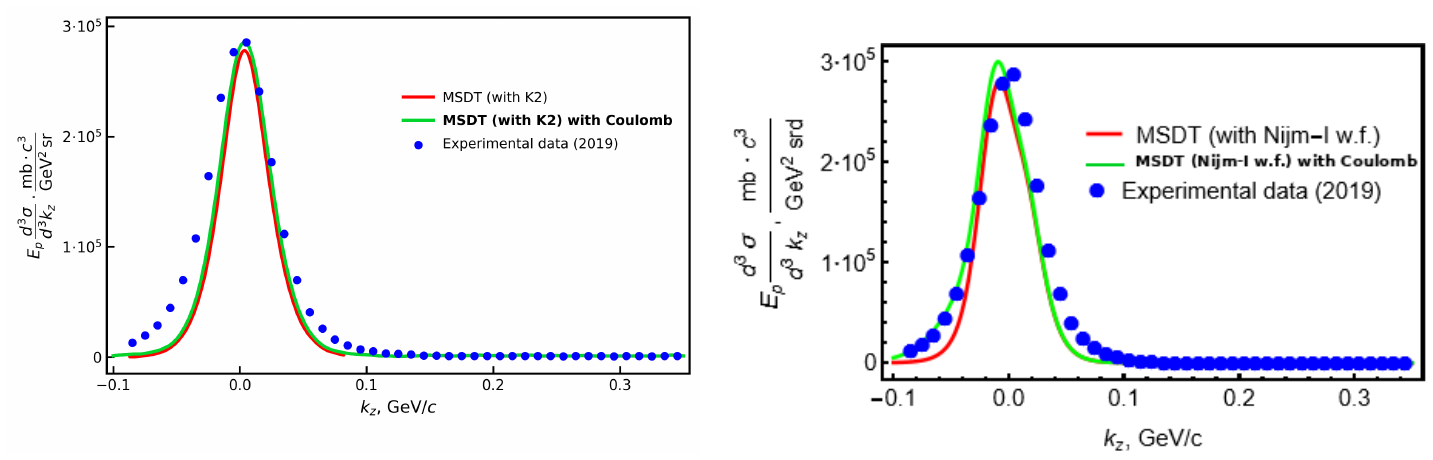
        $$F_{\rm tot}=F_{\rm str}+\Delta F_{Cp}+\Delta F_{Cpn}+O(\eta^2),$$ where $\Delta F_{Cp}$ corrects the proton line and $\Delta F_{Cpn}$ corrects double $pn$ rescattering. Thus Coulomb--nuclear interference is retained, and the two-dimensional rescattering term is reduced to a one-dimensional radial integral, extending earlier Coulomb treatments of $A(d,p)X$ breakup [1]. **Figure 1.** Results for $^{12}C(d,p)X$. Left panel: K2 wave function with $\sigma_{pN}=390$ mb, $\beta_p=1.22$ fm$^{-1}$, $\mu=0.25$ fm, $a=1$, $k_x=10^{-4}$ GeV/$c$, and $Q_z=-2.5\times10^{-3}$ GeV/$c$. Right panel: Nijm-I wave function with $\sigma_{pN}=350$ mb, $\rho_{pN}=10^{-4}$, $p_d=9.1$ GeV/$c$, $\beta_p=2.19$ fm, $\mu=10^{-6}$, $a=\alpha_L=1$, $k_x=-0.26$ GeV/$c$, $k_y=0$, and $Q_z=-2.5\times10^{-3}$ GeV/$c$. The calculated grid is $-0.10\leq k_z\leq0.25$ GeV/$c$ with $\Delta k_z=0.0125$ GeV/$c$. Therefore, $k_\perp=0.26$ GeV/$c$ and is nonzero in the antilaboratory system. Red curve: strong MSDT; green curve: MSDT with Coulomb; blue points: 2019 data [5]. Both the K2 and Nijm-I calculations show that Coulomb--nuclear interference increases the narrow quasifree peak and improves its normalization, while becoming small at $0.3$--$0.5$ GeV/$c$. Thus, $Q_z$ and $k_\perp$ govern the kinematic displacement and broadening, whereas the finite-size Coulomb interaction mainly renormalizes the low-momentum peak. This provides a baseline for final-state interactions and for relativistic refinements not included here: invariant flux and phase-space Jacobians; Lorentz boosts between the antilaboratory and final-$pn$ center-of-mass frames; a covariant or light-front deuteron wave function with spin rotations; D-wave and nonnucleonic components.
        References

        [1] A. P. Kobushkin and Ya. D. Krivenko-Emetov, Ukr. J. Phys. 53, 751 (2008), arXiv:0712.1151 [nucl-th].

        [2] V. K. Tartakovsky, A. V. Fursaev, and B. I. Sidorenko, Phys. At. Nucl. 68, 33--41 (2005), doi:10.1134/1.1858555.

        [3] Ya. D. Krivenko-Emetov and B. I. Sydorenko, Nucl. Phys. At. Energy 27, 16 (2026).

        [4] Ya. D. Krivenko-Emetov and B. I. Sydorenko, arXiv:2607.17222 [nucl-th] (2026).

        [5] I. Sitnik, EPJ Web Conf. 204, 10011 (2019).

        Keywords: deuteron; inclusive breakup; Glauber--Sitenko theory; longitudinal momentum transfer; Coulomb--nuclear interference; deuteron wave function

        Speaker: Yaroslav KRYVENKO-EMETOV (National Technical University of Ukraine "Igor Sikorsky Kyiv Polytechnic Institute" & Institute for Nuclear Research)
      • 16:25
        Hadronic and partonic composition of QCD matter across the crossover 5m

        We construct a simple equation of state of strongly interacting matter at zero chemical potentials that provides a unified description of lattice QCD thermodynamics in terms of hadronic and partonic degrees of freedom. The hadronic phase is described by the quantum van der Waals hadron resonance gas, extended by excluded-volume repulsion between mesons, while the quark-gluon plasma is modeled as an ideal gas of quarks and gluons supplemented with a phenomenological interaction term proportional to $T^3$. The two regimes are connected by a smooth crossover switching function. The three model parameters - the meson hard-core radius, the strength of the partonic interaction term, and the switching temperature - are determined from a fit to lattice QCD results for the trace anomaly. The resulting equation of state reproduces the lattice data on the pressure, entropy density, energy density, and speed of sound in the temperature range $T=100-500$ MeV. The fit yields a meson hard-core radius $r_M \simeq 0.2$ fm, a partonic interaction scale $A \simeq 600$ MeV, and a switching temperature $T_0 \simeq 216$ MeV, substantially exceeding both the pseudocritical temperature of the QCD chiral crossover and the chemical freeze-out temperature. This finding suggests that the transition from hadronic to partonic degrees of freedom is considerably more gradual than indicated by the chiral pseudocritical temperature alone, with hadronic states remaining an important component of strongly interacting matter up to temperatures of about $250$ MeV, well above the QCD chiral crossover.

        Speaker: Artemiy Lysenko (Bogolyubov Institute of Theoretical Physics)
      • 16:30
        Theoretical analysis of astrophysical S-factors of nuclear reactions 7Be(n,α)4He and 7Be(n,p)7Li 5m

        Theoretical analysis of astrophysical S-factors of nuclear reactions
        $^{7}$Be(n,$\alpha )^{4}$He and $^{7}$Be(n,p)$^{7}$Li

        V.I. Zhaba, V.S. Vasilevsky, Yu.A. Lashko

        Bogolyubov Institute for Theoretical Physics, National Academy of Sciences
        of Ukraine

        In this report, we study a range of reactions induced by the interactions $^{7}$Li+p, $^{7}$Be+n and $^{6}$Li+d. Special attention is paid to the low-energy region in the input channels of reactions that take into account the dynamics of synthesis and decay of $^{6}$Li, $^{7}$Li and $^{7}$Be nuclei. This study is performed within a microscopic three-cluster model, which allows us to involve all binary channels of the $^{8}$Be decay. Besides, this model takes into account polarizability of interacting nuclei (clusters) [1, 2]. In Ref. [3], this model was successfully applied to study the structure of the $^{8}$Be nucleus and the nature of high-energy resonance states of $^{8}$Be.
        Within the framework of our model, the astrophysical S-factors of the reactions $^{7}$Be(n,$\alpha )^{4}$He, $^{7}$Be(n,p$_{0})^{7}$Li and $^{7}$Be(n,p$_{1})^{7}$Li in the energy range E$_{cm}$=0-2 MeV were calculated. The dependence of the astrophysical S-factors on the form and intensity of the nucleon-nucleon interaction was investigated in detail. For the astrophysical S-factor of $^{7}$Be(n,$\alpha)^{4}$He reaction, the partial 2$^{+}$ wave dominates over the entire energy range, and is then enhanced by the 0$^{+}$ wave. The calculated S-factors for $^{7}$Be(n,$\alpha )^{4}$He reaction are further decomposed into contributions from reactions with $^{7}$Be in its ground and first excited states. For $^{7}$Be(3/2$^{-}$)(n,$\alpha)^{4}$He reaction, the 2$^{+}$ wave has a maximum that is due to resonance. In our microscopic model, this 2$^{+}$ resonance state appears at energy E$\approx $1.27 MeV above $^{7}$Be+n decay threshold, which is in good agreement with the experimental data obtained in [4].
        For $^{7}$Be(n,p$_{0})^{7}$Li reaction, the 3$^{+}$ partial wave dominates in the region of the maximum at Ecm=0.5 MeV, while the 2$^{-}$ partial wave determines the behavior at low and high energies. For $^{7}$Be(n,p$_{1})^{7}$Li reaction, the 1$^{-}$ partial wave dominates in the entire energy range and together with the $^{+}$, 2$^{-}$, 2$^{+}$ states provide the main contribution to the astrophysical S-factor. It was demonstrated that the cluster polarization has a large impact on value and energy dependence of the S-factor for the $^{7}$Be(n,p)$^{7}$Li reaction.
        The calculated astrophysical S-factors for the reactions $^{7}$Be(n,$\alpha)^{4}$He and $^{7}$Be(n,p)$^{7}$Li are in good agreement with experimental data from leading laboratories. Our partial astrophysical S-factors for the $^{7}$Be+n reactions are compared with calculations in the R-matrix theory and with data in the ENDF database.

        [1] Y.A. Lashko, G.F. Filippov, V.S. Vasilevsky. Nucl. Phys. A 958, 78 (2017).
        [2] V.S. Vasilevsky, F. Arickx, J. Broeckhove, T.P. Kovalenko. Nucl. Phys. A
        824, 37 (2009).
        [3] V.I. Zhaba, Yu.A. Lashko, V.S. Vasilevsky. Phys. Rev. C 112 014328 (2025).
        [4] D.R. Tilley, J.H. Kelley, J.L. Godwin et al. Nucl. Phys. A 745 155 (2004).

        Speaker: Victor Zhaba (Інститут теоретичної фізики ім. М.М. Боголюбова НАН України)
      • 16:35
        Interacting Relativistic Bosons at Finite Temperatures: Comparison with Lattice QCD 5m

        We study an interacting relativistic system of charged bosons at finite temperature and fixed isospin density within a thermodynamically consistent mean-field approach. Two forms of repulsive self-interaction, $φ^4$ and $φ^6$, are considered. The interactions lead to a density-dependent effective mass $M$ of the bosonic quasiparticles and an associated excess-pressure contribution. The thermodynamics is formulated in the Extended Canonical Ensemble, obtained from the grand canonical description by a Legendre transformation from the isospin chemical potential to the conserved isospin density. This formulation is particularly useful in the Bose-condensed phase, where the isospin chemical potential is constrained by the condensation condition, $μI = M$, and must be determined self-consistently.
        The formalism is applied to a pion-like system at finite isospin density and compared with lattice-QCD results. We discuss the difference between the isospin chemical-potential conventions used for pion and quark degrees of freedom and adopt the convention in which the condensation threshold is $μI = mπ/2$. At $T = 122$ MeV, the pressure, isospin density, energy density, and trace anomaly are compared with lattice data. Both the $φ^4$ and $φ^6$ models reproduce the main features of the lattice results, with the φ6 interaction providing a better overall description. The results demonstrate that the Extended Canonical Ensemble provides a consistent framework for describing interacting particle-antiparticle systems across the transition from the thermal to the Bose-condensed phase.

        This work was funded by National Research Foundation of Ukraine grant 2025.07/0461.

        Speaker: Denys Zhuravel (Bogolyubov Institute for Theoretical Physics of the National Academy of Sciences of Ukraine)
      • 16:40
        Strain Engineering of Flexo-Phonons and Flexo-Ferrons in Thin Films of Van der Waals Ferrielectrics 5m

        It was shown earlier that size effect of soft phonon dispersion is principally important in nanosized ferroics [1]. Also, the size and strain effects can determine the anomalous polarization reversal in strained thin films of van der Waals ferrielectrics [2]. It has been shown recently that the influence of the flexoelectric coupling (shortly “flexocoupling”) on the fluctuations of electric polarization and elastic strains can lead to the principal changes of the dispersion law of soft optical and acoustic phonons (shortly “flexophonons”) and ferrons (shortly “flexoferrons”) in a bulk van der Waals ferrielectrics [3]. At that applied electric field influences strongly on the anisotropic dispersion of the flexocoupling induced phonons and ferrons in van der Waals ferrielectrics [4]. A strong coherent ferrons and cavity acoustic phonons is predicted in the of van der Waals ferrielectric $CuInP_2 S_6$ [5].
        Using the Landau-Ginzburg-Devonshire approach, in this work we reveal that the dispersion of flexophonons and flexoferrons is strongly dependent on the sign and magnitude of elastic strains originated from the lattice constants mismatch in thin strained films of van der Waals ferrielectric $CuInP_2 S_6$. In particular, the frequency of acoustic flexophonons and flexoferrons tends to zero at nonzero wavevectors $k>k_{cr}$, where the critical value of the wavevector $k_{cr}$ is determined by the mismatch strain and flexocoupling strength. Zeroing of the flexophonon frequency, that appears with increase of tensile strains, indicates a possible emergence of a spatially modulated incommensurate polar phase induced by the flexo-strain effects. Analytical results, derived in this work, open the way for strain engineering of flexophonon and flexoferron dispersion in thin films of van der Waals ferrielectrics.
        Acknowledgements. The work is primary supported as part of the Computational Materials Sciences Program funded by the US Department of Energy, Office of Science, Basic Energy Sciences, under Award Number DE-SC0020145. The part of A.N.M. and E.A.E. efforts are also supported by National Academy of Sciences of Ukraine (grants No. 5.8/26-П, 1.4.B/222, III-6-26).
        References
        1. A. N. Morozovska, and E. A. Eliseev. Size effect of soft phonon dispersion law in nanosized ferroics. Phys.Rev. B, 99, 115412 (2019); https://link.aps.org/doi/10.1103/PhysRevB.99.115412
        2. A. N. Morozovska, E. A. Eliseev, A. Ghosh, M. E. Yelisieiev, Y. M. Vysochanskii, and S. V. Kalinin. Anomalous Polarization Reversal in Strained Thin Films of CuInP2S6, Phys. Rev. B, 108, 054107 (2023); https://link.aps.org/doi/10.1103/PhysRevB.108.054107
        3. A. N. Morozovska, E. A. Eliseev, O. V. Bereznikov, M. Ye. Yelisieiev, G.-D. Zhao, Y. Zhu, V. Gopalan, L.-Q. Chen, J.-M. Hu, and Y. M. Vysochanskii, Flexo-coupling induced phonons and ferrons in Van der Waals ferroelectrics, Physical Review B 112, 014110 (2025); https://doi.org/10.1103/mr9v-khtj
        4. A. N. Morozovska, E. A. Eliseev, Y. Zhu, Y. M. Vysochanskii, V. Gopalan, L.-Q. Chen, and J.-M. Hu, The Influence of Electric Field on the Anisotropic Dispersion of the Flexocoupling Induced Phonons and Ferrons in Van der Waals Ferrielectrics. Journal of Applied Physics, 138, 134101 (2025); https://doi.org/10.1063/5.0294057
        5. Y. Zhu, Ji. Wu, A. N. Morozovska, E. A. Eliseev, Y. M. Vysochanskii, V. Gopalan, L.-Q. Chen, X. Zhang, W. Zhang, J.-M. Hu. Strong coupling between coherent ferrons and cavity acoustic phonons. Physical Review Applied (2026); https://doi.org/10.1103/q9np-lk7y

        Speaker: Eugene Eliseev (Frantsevich Institute for Problems in Materials Science, National Academy of Sciences of Ukraine)
      • 16:45
        Machine learning to determine the fitting parameters of ferroelectric-dielectric nanocomposites dielectric response 5m

        One of the problems of analyzing experimental electrophysical dependences is determining the parameters of the theoretical model that best reproduces the form of measured dielectric response of ferroelectric-dielectric nanocomposites. For complex nonlinear models, such a problem may have several close solutions, be sensitive to the initial approximation, and require significant computational costs. We investigated the possibility of using machine learning for automated determination of the parameters of a physical model intended for forming an experimental state of the ferroelectric-dielectric nanocomposites. The study of ferroelectric-dielectric nanocomposites was conducted based on the Effective Medium Approximation (EMA) [1] and Heywang models [2]. For each model, a set of curves was formed when varying its physical parameters in given regions. Thus, each curve corresponds to a known set of parameters, which allowed us to form a training sample for the regression problem.
        Typically, EMA considers a quadratic equation for the effective permittivity of a binary mixture:
        $(1-μ) \frac{(ε_{eff}^*-ε_{b}^*)}{(1-n_a ) ε_{eff}^*+n_a ε_b^*}+μ \frac{(ε_{eff}^*-ε_a^*)}{(1-n_a ) ε_{eff}^*+n_a ε_a^*}=0$ (1)
        here $ε_a^*, ε_b^*$ are the relative complex permittivities of components "a" and "b" respectively, $μ$ and $1-μ$ are the relative volume fractions of components "a" and "b" respectively, and $n_a$ is the depolarization field factor for the inclusion of type "a".
        Following Heywang model, the expected Arrhenius-type and/or the Mott-type temperature dependences (as well as a general stretched-exponential law) for the effective conductivity of the nanopowders could be modified by introduction of the effective dielectric permittivity. Thus, we use the following fitting function for effective conductivity:
        $σ_eff (T,ω)=σ_A^0 (ω)exp[-(\frac{E_A}{(k_B Tε_{eff}(T))}^λ ]$. (2)
        Here $E_A$ is an activation energy of the space charges in the cores/shells (A = C or S). The positive fitting parameter $λ$ varies in the range $0<λ≤1$ for a general stretched-exponential law, which includes the Mott law with $λ=1⁄4$ and the Arrhenius law with $λ=1$. Varying $λ$ one can simulate a possible crossover from the Arrhenius-type dependence to the Mott-type dependence of the effective conductivity.
        The analysis shows that it is most appropriate to use machine learning not for direct approximation of the experimental curve by an arbitrary function, but for identification of parameters of a predetermined physical model. In this case, the result of the algorithm remains physically interpretable, and its correctness can be independently verified by restoring the original dependence. The proposed approach allows us to move from sequential numerical fitting of each experimental curve to automated determination of the physical parameters of the ferroelectric-dielectric nanocomposites and can be used for big data analysis.
        Acknowledgements. The work is primary supported the by National Academy of Sciences of Ukraine (grants No. 5.8/26-П and 1.4.B/222).
        References
        [1]. T.C. Choy. Effective Medium Theory. Oxford (UK): Clarendon Press; 1999. ISBN 978-0-19-851892-1.
        [2]. W. Heywang. Semiconducting Barium Titanate. J. Materials Science 6, 1214 (1971); https://doi.org/10.1007/BF00550094.

        Speaker: Mr Oleksii Bereznykov (Institute of Physics, NAS of Ukraine)
      • 16:50
        Electronic structure and stability of complexes Ag+ with nucleotide base pairs 5m

        Metallized DNA is of considerable interest due to its potential application in molecular electronics. Therefore, the fundamental properties of this system are of paramount interest, in particular those related to electronic structure and dynamics of metallized base pairs. In this work, two different structural motifs of Ag-DNA known from the experiment [1,2] were investigated: one that preserves Watson-Crick base pairing with Ag⁺ ions included in the base pairs (based on experiment [1]), and the other that breaks the base pairing (based on experiment [2]). The fundamental questions concerning their relative energetic stability and thermodynamics of formation were considered. To answer these questions the detailed quantum-chemical calculations were performed at the DFT level using the B3LYP functional in the Gaussian 03 software package. Ag+ ions were described by the Def2-TZVP basis set with effective core potential (ECP). Nucleotide base atoms were described by the all-electron basis set 6-311++G(d, p). Solvation effects of the aqueous environment were taken into account using the SMD model. Dispersion corrections were taken into account using method Grimme's of D3. This calculation method for the studied systems was chosen based on the results of our previous work [3]. Several sets of systems were investigated, both with and without Ag+, including purine-Ag-purine, pyrimidine-Ag-pyrimidine, 7-deazapurine-Ag-pyrimidine, and canonical Watson-Crick base pairs. The highest thermodynamic stability was demonstrated by the neutral complex [7-deazaguanine(N1)-Ag+-cytosine(N3)]0, which outperforms its canonical counterpart [guanine(N1)-Ag+-cytosine(N3)]0. Analysis of the calculated IR and Raman vibrational spectra revealed pronounced spectral changes that can be used to characterize the presence of Ag⁺ ions in the DNA double helix. In particular, vibrations associated with the motion of Ag⁺ ions were detected in the low-frequency region (<250 cm⁻¹).

        Acknowledgments. The authors thank the financial support from the National Research Foundation of Ukraine (project № 2025.07/0355).

        1. Javornik U., Pérez-Romero A., López-Chamorro C., et al. Unveiling the solution structure of a DNA duplex with continuous silver-modified Watson-Crick base pairs // Nature Commun.-2024.-15, N 1.-P. 7763.
        2. Kondo J., Tada Y., Dairaku T., et al. A metallo-DNA nanowire with uninterrupted one-dimensional silver array // Nature Chem.-2017.-9, N 10.-P. 956-960.
        3. Osokin Y., Perepelytsya S. Stability of Ag-DNA nucleotide base complexes: A quantum-chemical study // Low Temp. Phys.-2026.-52, N 5.-P. 542-552.
        Speaker: Yevhen Osokin (Bogolyubov Institute for Theoretical Physics)
      • 16:55
        Quantum-Chemical Study of the Interactions between DNA Phosphate Groups and Monovalent Ions 5m

        The complexes of monovalent ions (Li$^+$, Na$^+$, K$^+$) with DNA phosphate groups are considered in the present work. The complexes are studied from the simplest to the more complicated ones. In addition, chloride ions (Cl$^-$) and water molecules are introduced to make the complexes more realistic. Optimized geometries, interaction energies, and vibrational spectra are calculated using density functional theory method (DFT) within the framework of the Gaussian 03 software package.
        It is shown that the lithium ion has a tetrahedral hydration shell. The calculated interaction energies show that complexes containing Li$^+$ and two phosphate groups are energetically more stable than the corresponding complexes containing sodium or potassium ions. IR and Raman spectra are obtained, and all the main vibrational modes are identified. Some of the calculated vibrational modes are in good agreement with experimental data.
        The results of the present work may play a crucial role in understanding the possible condensation of DNA molecules in solution in the presence of Li$^+$ ions, as suggested by some recent molecular dynamics calculations.

        Acknowledgements: The study was supported by National Research Foundation of Ukraine (project No 2025.07/0355).

        Speaker: Dmytro Piatnytskyi (Bogolyubov Institute for Theoretical Physics)
      • 17:00
        Charge density oscillations around the DNA double helix 5m

        The DNA macromolecule has nanometer dimensions, a double helix structure consisting of chemically bonded atoms, and a large negative charge. Being in an aqueous environment or inside cells, the DNA macromolecule interacts mainly through electrostatic forces, hydrogen bonds, hydration and biochemical bonding, including medium ions, so the environment strongly influences DNA conformation, stability and biological functions. Positively charged ions, named counterions, in the aqueous medium around the DNA macromolecule, play an important role as a screening cloud. Their motion is typically considered as strongly damped, in particular due to medium viscosity and collisions, and therefore, counterion distribution is usually calculated in the electrostatic approximation. However, some studies demonstrate the possibility of high translational mobility of counterions in the screening cloud and their high-frequency movements inside the hydrated shells. Thus, a counterion evolution around the DNA double helix remains an important problem.
        We considered kinetic equations in the collisionless approximation and the DNA macromolecule approximation as a charged cylinder with a weak and moderate electric field to describe the counterion distribution evolution in the electric field of the DNA macromolecule. Using such approximations, the dispersion equations for counterion oscillatory dynamics with an infinite number of oscillatory branches are obtained. It is demonstrated that each of such branches is purely real if it is far from other branches, while the intersection with other branches leads to instability. The upper bound of the instability coefficient of the mode, which appears at the branch intersection point, is estimated.

        The author thanks to COSY COST Action CA21101; National Research Foundation of Ukraine (project № 2025.07/0355).

        Speaker: Oleksandr Cherniak (Bogolyubov Institute for Theoretical Physics)
      • 17:05
        Comparative Analysis of Ion-Specific Effects on the Electrophysical and Rheological Properties of DNA Aqueous Solutions with LiCl, NaCl, and KCls 5m

        DNA is a strong polyanionic polyelectrolyte with the properties, which are largely governed by interactions with charged ions (counterions) in aqueous solution. Alkali metal cations differ substantially in ionic radius, charge density, and hydration enthalpy, which in turn determine how strongly they bind to the phosphate backbone, reorganize the surrounding hydration shell, and affect macroscopic transport and hydrodynamic properties of the solution [1,2].
        This work presents a comparative analysis of the electrical conductivity and viscosity of aqueous high-molecular-weight DNA solutions in the presence of LiCl, NaCl, and KCl across a common range of salt concentrations and temperatures. Rather than treating each system in isolation, the ionic series Li⁺ → Na⁺ → K⁺ is examined as a single trend, allowing the relative contributions of cation size and hydration strength to charge transport and DNA conformational behavior to be disentangled. Comparison of the conductivity and viscosity responses reveals systematic, ion-specific deviations that correlate with the strength of cation–phosphate binding and the degree of ion dehydration upon association with DNA. The concentration- and temperature-dependence of these deviations further indicates how the balance between electrostatic screening and hydration-shell restructuring shifts along the Li⁺–Na⁺–K⁺ series.
        These comparative trends provide a more direct route to identifying the mechanisms underlying ion-specific effects in DNA–electrolyte systems than analysis of individual salts alone, and contribute to a more general understanding of counterion selectivity in polyelectrolyte solutions.
        [1]. Ross, P. D., & Scruggs, R. L. (1968). Viscosity study of DNA. II. The effect of simple salt concentration on the viscosity of high molecular weight DNA and application of viscometry to the study of DNA isolated from T4 and T5 bacteriophage mutants. Biopolymers, 6(8), 1005–1018. https://doi.org/10.1002/bip.1968.360060805
        [2]. Perepelytsya, S., Piatnytskyi, D., Bubon, T., Cibotariu, N., Laaksonen, A., & Mocci, F. (2026). Ions as architects of DNA nanostructures: Mechanisms, simulations, and technological frontiers. Small Structures, 7, e202500786. https://doi.org/10.1002/sstr.202500786

        Speaker: Mrs Mariia Sosnovska (Taras Shevchenko National University of Kyiv)
      • 17:10
        Non-stationary longitudinal Josephson effect in bilayer systems with electron-hole pairing 5m

        The non-stationary longitudinal Josephson effect in bilayer systems with pairing of spatially separated electrons and holes is investigated [1]. The tunneling current between two weakly coupled electron-hole condensates (right and left) is analyzed in the presence of an external voltage applied along the layers. Two limiting regimes are considered: the high-density regime, where pairing occurs in momentum space similarly to conventional superconductors, and the low-density regime corresponding to a Bose-Einstein condensate of spatially indirect excitons. Using the tunneling Hamiltonian approach, expressions for the quasiparticle, superconducting, and interference contributions to the tunneling current are derived. It is shown that in the high-density limit, the quasiparticle and interference currents vanish at zero temperature below a threshold voltage determined by the energy gap, so that only the supercurrent remains. In contrast, in the low-density regime, the gapless spectrum of collective excitations leads to finite dissipative contributions even at zero temperature, resulting in damping of Josephson oscillations. For spatially separated tunneling barriers with a distance exceeding the coherence length, phase jumps occur at each barrier, resulting in voltage oscillations across the electron and hole barriers and a nonsinusoidal current-phase relation governed by the critical currents of the two barriers. Observation of the characteristic features of the longitudinal Josephson effect would provide direct evidence of superfluidity in the bilayer exciton condensate [2].

        [1] O. M. Konstantynov and S. I. Shevchenko, Low Temp. Phys. 52, 1063 (2026). https://doi.org/10.1063/10.0044481
        [2] F. Pascucci, A. R. Hamilton, M. V. Milošević, and D. Neilson, arXiv:2606.23303 (2026). https://doi.org/10.48550/arXiv.2606.23303

        Speaker: Oleksandr Konstantynov (B.Verkin Institute for Low Temperature Physics and Engineering of the National Academy of Sciences of Ukraine)
      • 17:15
        Quantum chemical study of methanol interaction with a pyrene-based acid 5m

        Quantum chemical study of methanol interaction with a pyrene-based acid

        Kremen O. S.1, Bychko I. B.2, Nikolaienko T.Y.3, Lobanov V. V.1, Strizhak P. E.2

        1Chuiko Institute of Surface Chemistry of the NAS of Ukraine,
        Oleh Mudrak Str., 17, Kyiv-03164, Ukraine, kremenoksana@ukr.net
        2L. V. Pisarzhevskii Institute of Physical Chemistry of the NAS of Ukraine,
        Prospect Nauki, 31, Kyiv-03028, Ukraine
        3Taras Shevchenko National University of Kyiv, Faculty of Physics,
        Volodymyrska Str., 64/13, Kyiv 01601, Ukraine*

        The conversion of methanol (MeOH) to dimethyl ether (DME) is a large-scale industrial process, and developing advanced catalysts to reduce costs is important. Oxygen-containing carbons are promising metal-free catalysts for many reactions; therefore, this report presents quantum-chemical calculations (DFT, M062X/6-31G**/D3, ORCA 6.0.0) of the interaction between MeOH and pyrene-based acid (Pyr) in the gas phase at T = 0 K to elucidate the initial interaction mechanism for further investigation of the Methanol-to-DME conversion.

        Geometry optimisation yielded two acid isomers (A and B), depending on the orientation of the –COOH group plane relative to the aromatic plane. The –COOH group was covalently bonded to the terminal hexagonal carbon atom (alpha carbon) of the Pyr molecule (instead of a hydrogen atom) in the so-called syn conformation (where the O=C–O–H dihedral angle (θ) is defined to be 0°). Isomer A has a more twisted –COOH group relative to the aromatic core (θ=19.96°) than isomer B (θ=0.82°), due to the asymmetry of the carbon skeleton. The total energy of the planar B-Pyr acid is lower by 5.95 kJ/mol than that of the twisted A-Pyr acid molecule.

        Bader's Quantum Theory of Atoms in Molecules was used to identify the presence or absence of intramolecular hydrogen bonds (HB) in Pyr. The topological analysis of the electron density distribution confirmed the presence of two intramolecular HBs in the B-Pyr (between O atoms of the –COOH group and H atoms of the aromatic core), as evidenced by the presence of the corresponding bond critical points (BCPs) of type (3, −1). In contrast, only a single intramolecular HB was observed in the A-Pyr acid (between the O atom of the –OH group and the hydrogen atom of the aromatic core). Despite the C=O···H–C length being 2.361 Å (less than the sum of the van der Waals radii of the O and H atoms, which is 2.5 Å), there are no BCPs according to Bader’s analysis. Two possible ways of MeOH interaction with the B-Pyr acid are considered: formation of a cyclic complex (CC) and attack of the –C=O of the Pyr by MeOH. The CC is stabilised by two intermolecular HBs, forming a six-membered ring (6MR) between the –COOH group atoms of the Pyr acid and the –OH group atoms of the MeOH molecule. The interaction energy is –66.48 kJ/mol. The CC have two tautomeric forms (causing asymmetry in the carbon skeleton), more twisted CCa and CCb, which can interconvert through an activation barrier of 42.40 kJ/mol. The transition state (TS) for the transition between CCa and CCb structural isomers is characterised by a flip-flop switching of a hydrogen atom between adjacent acceptor centres (two O atoms of the –COOH group and one O atom of the MeOH), forming a two-sided hydrogen trap. The configuration of CCb is thermodynamically more stable than CCa, since its formation energy is lower by 4.43 kJ/mol.

        In the second pathway, the MeOH molecule attacks the C=O bond of the Pyr, forming a tetrahedral structure because the carbon atom orbitals in the –COOH group change hybridisation from sp2 to sp3. This atom is bound to four substituents: a Pyr-based group (–C16H9), two –OH groups and a single methoxy group (–OCH3). The analysis of the atomic vibrations for the cyclic four-membered TS structure confirmed the presence of a single imaginary frequency at i1620.70 cm–1. The activation barrier is +169.01 kJ/mol, and the adsorption energy is +23.88 kJ/mol.

        Based on the obtained energetic parameters, it was established that the bonding of the MeOH molecule preferentially proceeds via the formation of 6MR CC structures, as this pathway is significantly more energetically favourable than direct attack on the C=O bond of the –COOH group.

        This research was partially funded by the National Research Foundation of Ukraine (grant 2023.03/0041).

        Speaker: Ms Oksana Kremen (Chuiko Institute of Surface Chemistry of National Academy of Sciences of Ukraine)
      • 17:20
        Effect of fluorination on the molecular electrostatic potential of itic non-fullerene acceptors 5m

        Organic solar cells based on non-fullerene acceptors (NFAs) are a promising direction in the development of organic photovoltaics due to the possibility of targeted molecular design and control of their electronic and optical properties. Particular attention is paid to A–D–A-type acceptors, including ITIC and its fluorinated derivatives, for which the introduction of fluorine atoms provides an effective approach to modifying the electronic structure and electron-accepting properties of the molecules. In this work, a quantum-chemical study of ITIC, ITIC-2F, and ITIC-4F molecules was performed using density functional theory (DFT) and time-dependent DFT (TD-DFT). Geometry optimizations were carried out at the B3LYP/6-31G(d,p) level, followed by analysis of the electronic structure, frontier molecular orbitals (HOMO/LUMO), and molecular electrostatic potential (MEP). It was found that sequential fluorination has a negligible effect on the molecular geometry. All studied systems retain an almost planar π-conjugated structure, with changes in the dihedral angles not exceeding 0.12°. This indicates that the effect of fluorination on the electronic properties is governed predominantly by electronic rather than structural factors.
        Analysis of the frontier molecular orbitals showed that the HOMO is predominantly localized on the central donor IDTT core, whereas the LUMO is mainly concentrated on the terminal acceptor fragments. Upon going from ITIC to ITIC-4F, the HOMO energy decreases from −5.380 to −5.508 eV, while the LUMO energy decreases from −3.309 to −3.464 eV. The stabilization of the LUMO is more pronounced and is attributed to the electron-withdrawing inductive effect of the fluorine atoms. Particular attention was paid to the analysis of the molecular electrostatic potential. The MEP maps show that, for ITIC, ITIC-2F, and ITIC-4F, the most negative electrostatic potential is predominantly localized on the terminal electron-accepting fragments, particularly near the carbonyl groups. In contrast, the central conjugated core is characterized by a predominantly neutral or weakly positive potential.
        Fluorination does not alter the overall topology of the MEP distribution but systematically affects its local intensity. For ITIC-2F, an increase in the negative electrostatic potential is observed in the terminal acceptor regions, while this effect becomes more pronounced for ITIC-4F. At the same time, the central part of the molecule becomes more positive, indicating enhanced intramolecular polarization and redistribution of electron density from the central conjugated core toward the peripheral acceptor fragments.
        Thus, the MEP analysis (fig.) is consistent with the spatial distribution of the LUMO and confirms an enhanced electron-accepting character of the peripheral fragments upon fluorination. The observed modification of the electrostatic polarization may affect the nature of intermolecular interactions and charge-transfer processes in ITIC-based molecular materials. The most pronounced changes are observed for ITIC-4F containing four fluorine atoms.

        Fig. MEP mapped onto an electron density isosurface (ρ = 0.001 a.u.) for ITIC, ITIC-2F, and ITIC-4F molecules.

        Speaker: Dr Mariia Terebinska (Chuiko Institute of Surface Chemistry, NAS of Ukraine)
      • 17:25
        A Hypercomplex method of solving the piecewise-continuous Dirichlet problem for the Lamé system 5m

        A hypercomplex method for solving the piecewise-continuous Dirichlet problem for the Lamé system in domains with corner points has been developed, which is based on the representation of solutions using the components of a monogenic function in a commutative biharmonic algebra. Using a biharmonic integral of the Cauchy type, the Dirichlet problem has been reduced to a system of integral equations.
        References
        [1] Serhii Gryshchuk, Sergiy Plaksa, Piecewise-continuous Dirichlet problem for Lam\'{e} system, Ukr. mat. visnyk, Vol. 23, No. 2, pp. 171-200 (2026).

        Speaker: Serhii Gryshchuk (Institute of Mathematics of NAS of Ukraine, Zhytomyr Military Institute named after S.P. Korolyov)
      • 17:30
        The some solution of the Bryan-Pidduck equation 5m

        The Boltzmann equation [1] that describes the evolution of rarefied gases is one of the main equations of the kinetic theory of gases. For a model of rough spheres, the equation has the form:
        \begin{equation}
        D(f)= Q(f,f),
        \end{equation}
        where the left-hand side of the equation is the differential operator:
        $$ D(f)\equiv\frac{\partial f}{\partial t}+\left(V,\frac{\partial f}{\partial x}\right),$$ and the right-hand side of the Boltamann equation is the collision integral, which for the hard spheres model is as follows: $$Q(f,f)\equiv\frac{d^{2}}{2}\int_{R^{3}}\!\!\!dV_{1} \int_{R^{3}}\!\!\!d\omega_{1} \int_{\Sigma} d\alpha B(V-V_{1},\alpha)\Bigl[f(t,V_{1}^{*},x,\omega_{1}^{*})f(t,V^{*},x,\omega^{*})-f(t,V,x,\omega)f(t,V_{1},x,\omega_{1})\Bigl],$$ where $f(t,V,x,\omega)$ is the distribution function of particles. The problem of determination of the exact and approximate solutions of the Boltzmann equation in the explicit form is quite urgent. At present, the sole known exact solution of the Boltzmann equation is an expression usually called the Maxwell distribution or simply Maxwellian (after J. C. Maxwell, Scottish physicist). In the case of Maxwellians $M$, we get \begin{equation} D(f)=0, \quad Q(f,f)=0. \end{equation} The solution to this equation will be look for in the next form: $$ f(t,x,V,\omega)=\sum\limits_{i=1}^{\infty}\varphi_i(t,x)M_i(t,x,V,\omega).$$ As a measure of the deviation between the parts of the Boltzmann equation we will consider a uniform-integral error of the form: $$\Delta=\sup_{(t,x)\in \mathbb{R}^4}\int_{\mathbb{R}^3}dV \int_{\mathbb{R}^3}d\omega\Big|D(f)-Q(f,f)\Big|. $$

        In the paper[2], we were obtained sufficient conditions for the coefficient functions and hydrodynamic parameters appearing in the distribution, which enable one to make the analyzed error as small as desired.

        REFERENCES

        [1] S. Chapman and T.G. Cowling. The Mathematical Theory of Non-Uniform Gases. Cambridge Univ. Press, Cambridge, 1952.

        [2] V. Gordevskyy and O. Hukalov; The Interaction of a Countable Number of Eddy Flows for the Bryan-Pidduck Model. J. Math. Phys. Anal. Geom. 2025, 21, 218-231.

        Speaker: Oleksii Hukalov (B.Verkin Institute for Low Temperature Physics and Engineering of the NAS of Ukraine)
      • 17:35
        Representations of solutions for a first order quasilinear equation in a form of series in powers of the copolynomial δ-function 5m

        By a copolynomial we mean here a linear functional on the space of polynomials $\mathbb{R}[x]$. The space of copolynomials is denoted by $\mathbb{R}[x]'$. If $T\in\mathbb{R}[x]'$ and $p\in\mathbb{R}[x]$, then the result of application of $T$ to $p$ is written as $(T,p)$. The derivative $T'$ of a copolynomial $T\in\mathbb{R}[x]'$ is defined in the same way as in the classical theory of generalized functions: $(T',p)=-(T,p')$, $p\in\mathbb{R}[x]$. An important example of a copolynomial is the $\delta$-function, which is defined by $(\delta,p)=p(0)$, $p\in\mathbb{R}[x]$.

        The Cauchy-Stieltjes transform of a copolynomial $T\in\mathbb{R}[x]'$ is defined as the following formal Laurent series in the ring $s^{-1}\mathbb{R}[[s^{-1}]]$: $C(T)(s)=\sum_{k=0}^{\infty}(T,x^k)/s^{k+1}$. The mapping $C:\mathbb{R}[x]'\to s^{-1}\mathbb{R}[[s^{-1}]]$ is an isomorphism of these vector spaces. The multiplication of copolynomials is defined through the multiplication of their Cauchy-Stieltjes transforms. The theory of linear and nonlinear PDEs in the ring $\mathbb{R}[x]'[[t]]$ was studied in [1,2], respectively.

        Let $f(z)=\sum_{j=1}^{\ell}f_jz^j\in\mathbb{R}[z]$. We prove that the following Cauchy problem for the first order quasilinear equation

        $$ \frac{\partial u}{\partial t}+f(u)\frac{\partial u}{\partial x}=0, \qquad u(0,x)=\delta(x), $$ in $\mathbb{R}[x]'[[t]]$ has a unique solution $$ u(t,x)=\sum_{k=0}^{\infty}\sum_{|\alpha|=k} f_1^{\alpha_1}\ldots f_{\ell}^{\alpha_{\ell}} \frac{\left(\sum_{j=1}^{\ell}j\alpha_j+k\right)!} {\alpha_1!\ldots\alpha_{\ell}! \left(\sum_{j=1}^{\ell}j\alpha_j+1\right)!} \delta^{\sum_{j=1}^{\ell}j\alpha_j+k+1}(x)t^k, $$ where $\alpha=(\alpha_1,\ldots,\alpha_{\ell})\in\mathbb{N}_0^{\ell}$ is a multi-index, $|\alpha|=\sum_{j=1}^{\ell}\alpha_j$.

        Acknowledgement. Roman Skurikhin was supported by the National Research Foundation of Ukraine, project No. 2025.07/0369 “Qualitative methods of nonlinear analysis of heterogeneous structures”.

        [1] Gefter S. L., Piven' A. L.: Partial differential equations in module of copolynomials over a commutative ring, J. Math. Phys. Anal. Geom. 21 (2025), No. 1, 56–83.

        [2] Gefter S. L., Piven' A. L.: Nonlinear Partial Differential Equations in Module of Copolynomials over a Commutative Ring. J. Math. Phys. Anal. Geom. 21 (2025), No. 3, 319–345.

        Speaker: Roman Skurikhin (V. N. Karazin Kharkiv National University)
      • 17:40
        Symmetry analysis and exact solutions of a model describing viscous fingering induced by a chemical reaction 5m

        We study a mathematical model describing viscous fingering induced by the chemical reaction $A+B \to C$, introduced in [T. Gerard and A. De Wit, Phys. Rev. E, 2009]. The model couples the concentrations of the reactants, $u(t,x,y)$ and $v(t,x,y)$, and their product, $w(t,x,y)$, with the pressure $p(t,x,y)$ and the two-dimensional velocity field $U=(U_1,U_2)$, and is given by

        $ \nabla\cdot U=0, \ \kappa \nabla p=-\mu(w)U, \ u_t+ U\cdot\nabla u = d_1 \triangle u-kuv, $
        $v_t+ U\cdot\nabla v = d_2 \triangle v-kuv, \ w_t+U\cdot\nabla w = d_3 \triangle w+kuv.$

        The above system is investigated by means of the classical Lie symmetry approach. A Lie symmetry classification is obtained for different parameter cases, and the resulting symmetries are used to construct exact solutions. In the case of radially symmetric stream functions, several families of exact solutions are derived. These solutions make it possible to analyze the evolution of the reactant and product concentrations in both space and time and provide an analytical description of the corresponding viscous-fingering dynamics.

        The presented results were obtained in collaboration with R. M. Cherniha.

        Speaker: Dr Vasyl' Davydovych (Institute of Mathematics, NAS of Ukraine)
      • 17:45
        Low-order momentum correlation functions of the symmetric Tamm-Dancoff $q$-bosons, derived via under-trace operations 5m

        $\quad$Using the set of independent Symmetric Tamm-Dancoff (STD) type $q$-deformed quantum oscillators [1] with the standard linear-in-$N$ Hamiltonian, we construct respective gas of $q$-bosons. Such a deformed $q$-Bose gas model admits [2] exact analytic expressions for the $r$-particle momentum correlation function, and corresponding intercepts, of any $r$th order. This is the third example of deformed oscillators' based Bose gas model, along with the $qp$-Bose gas model [3] and the $\mu$-deformed one [4] (based on Jannussis's oscillator), where correlation average $\langle (a^\dagger_{\bf k})^r (a_{\bf k})^r \rangle$ was calculated explicitly. In view of the formal resemblance between the $qp$-bracket and the STD deformation structure function, with $N$-multiplier ignored, we apply the idea of the derivation from [3] for $qp$-bosons, to the current case of STD $q$-bosons.

        $\quad$Indeed, using just under-trace algebraic operations, for the STD $q$-bosons in a fixed $\bf k$-mode we find
        $\qquad\qquad \langle a^\dagger a\rangle_\mathrm{STD} = \frac1{(e^{\beta\omega} -\, q)^2}\, \biggl\{\ \Bigl\langle \frac{\bigl[a, [a,a^\dagger]_q \bigr]_q\, a^\dagger}{\varphi_\mathrm{STD}(N+1)} \Bigr\rangle + \frac{ [1]^\mathrm{STD}_q!\, e^{\beta\omega} }{\mathrm{Tr}\, e^{-\beta\omega N}} \biggr\}$
        versus $\langle a^\dagger a\rangle_{qp} = \frac{[1]_{qp}!}{e^{\beta\omega}\,-\,q} \, \bigl\langle[a,a^\dagger]_q\bigr\rangle$ for $qp$-bosons, see [3]. What concerns the quadratic correlations, using the same approach of under-trace transformations we derive
        $\qquad \bigl\langle a^{\dagger2}a^2 \bigr\rangle_\mathrm{STD} = \frac1{(e^{\beta\omega} -\, q^2)^3 (e^{\beta\omega} -\, 1)^3}\ \biggl\{\ \Bigl\langle \ \sum\limits_{i=0}^4 A_i(q)\; \textrm{g}_q(N\!+\!1\!+\!i)\,\textrm{g}_q(N\!+\!i) \cdot q^{-2N} \Bigr\rangle$
        $\qquad\qquad\qquad\qquad -\ (e^{\beta\omega}-1)\, \textrm{g}_q(0) P_2\bigl(q;e^{\beta\omega}\bigr) \biggr\}\ +\ \varphi_\mathrm{STD}(2)! \frac{e^{\beta\omega}-\,1}{(e^{\beta\omega}\,-\,q^2)^3}$
        where underlying role belongs to the double commutator as well, through $\textrm{g}_q(N)$-function, $[a,[a,a^\dagger]_q]_q = - \textrm{g}_q({N+1})\, q^{1-N} \cdot a$, and $P_2(q;e^{\beta\omega})$ is some quadratic polynomial in $e^{\beta\omega}$, with coefficients depending on $q$.

        1. W.S. Chung, A.M. Gavrilik, I.I. Kachurik,
          A.P. Rebesh: J. Phys. A: Math. Theor. 47, 305304 (2014).
        2. A.M. Gavrilik, Yu.A. Mishchenko, arXiv preprint,
          arXiv:1410.0538 (2014).
        3. L.V. Adamska, A.M. Gavrilik, J. Phys. A: Math. Gen.
          37, 4787-4796 (2004).
        4. A.M. Gavrilik, Yu.A. Mishchenko, Phys. Lett. A
          376, 2484-2489 (2012).
        Speaker: Yuriy Mishchenko (Bogolyubov Institute for Theoretical Physics of NAS of Ukraine)
      • 17:50
        Quantum Computing Study of the Speed of Quantum Evolution in the Ising Model in a Longitudinal Magnetic Field 5m

        The speed of quantum state evolution is a fundamental characteristic of quantum dynamics. As shown in [1], for pure quantum states, it is directly governed by energy fluctuations. In the present work, we examine the speed of quantum evolution in a spin system described by the Ising model and subjected to a longitudinal magnetic field. We perform analytical derivations and quantum computing using AerSimulator. The quantum programming of the speed of quantum evolution employs two distinct approaches: the estimation of the expectation value of the evolution operator for short times and the direct measurement of Pauli correlators [2]. The results of the quantum computations are in agreement with the theoretical results. We also show that the quantum states evolved in spin systems described by the Ising model in a magnetic field can be treated as quantum graph states representing vertex- and edge-weighted graphs. We establish relations between the speed of quantum evolution and the structural properties of the graph.
        [1] A. Shimony, Ann. N.Y. Acad. Sci. 755, 675-679 (1995). doi: 10.1111/j.1749-6632.1995.tb39008.x .
        [2] Kachmar, M., and Kh Gnatenko. (2025). Visnyk Lviv Univ., Ser. Phys. 62, 67–74 (2025). doi: 10.30970/vph.62.2025.67

        Speaker: Markiian Kachmar (Professor Ivan Vakarchuk Department for Theoretical Physics, Ivan Franko National University of Lviv)
    • 10:00 → 10:30
      Baryon fluctuation signatures of the onset of deconfinement 30m

      We predict an anomalous collision-energy dependence of proton-number
      fluctuations as a consequence of the onset of deconfinement in heavy-ion collisions at the nucleon-pair centre-of-mass energy (8 − 12) GeV. The effect arises from the change of properties of the effective degrees of freedom during the transition from confined and deconfined matter. The proposed interpretation provides a unified explanation of the collision-energy dependence of proton fluctuations together with the previously observed anomalies in hadron production, and yields semi-quantitative predictions without introducing parameters adjusted to the fluctuation data.

      Speaker: Prof. Mark Gorenstein (Bogolyubov Institute for Theoretical Physics, National Academy of Sciences of Ukraine)
    • 10:30 → 10:50
      Equation of State of Strongly Interacting Matter from Physics-Informed Neural Networks 20m

      Understanding the properties of strongly interacting matter is one of the central challenges in high-energy physics. In heavy-ion collisions, nuclei are smashed together at relativistic speeds to recreate extreme conditions of temperature and density, briefly producing a state of matter known as the quark-gluon plasma. This hot, dense matter behaves as a nearly perfect liquid — flowing with remarkably low viscosity — and is best described by relativistic hydrodynamics, whose key input is the equation of state encoding the system's thermodynamic properties.

      The underlying theory, quantum chromodynamics, cannot yet be solved from first principles across the full phase diagram. Lattice QCD is reliable only at low baryon chemical potential, while the hadron resonance gas model holds only at low particle densities. Between them lies a critical gap — one that coincides precisely with the region being probed by next-generation experiments such as RHIC BES, FAIR, and CBM.

      In this talk, I present a neural-network approach to bridging this gap. The network is trained to reproduce lattice QCD and hadron resonance gas thermodynamics in their regimes of validity, while extrapolating into the uncharted high-baryon-density region in a manner that remains thermodynamically consistent — enforced through convexity-preserving architecture and derivative constraints, in the spirit of physics-informed neural networks. The result is a four-dimensional equation of state, $P(T, μ_B, μ_Q, μ_S)$, spanning the full phase space relevant to heavy-ion collisions. I will conclude by showing how this equation of state is implemented within a full relativistic hydrodynamic simulation framework.

      This work was partially supported by the National Research Foundation of Ukraine (project № 2025.07/0050).

      Speaker: Musfer Adzhymambetov (Bogolyubov Institute for Theoretical Physics)
    • 10:50 → 11:10
      Particle multiplicity fluctuations of quantum origin and high-multiplicity pp collision events 20m

      The multiplicity dependence of the two-particle Bose-Einstein momentum correlation radii in pp collisions at the LHC has been measured at a fixed energy of collisions. One notable feature of these measurements is that the effective system’s volume, when extracted from the correlation radius parameters, appears to scale nearly linearly with charged-particle multiplicity [1-3], except for low multiplicities where initial state effects dominate and, quite unexpectedly, except for very high multiplicities where, at variance with the expected behavior for emission from hydrodynamically expanding systems, one sees systematic deviations from such a scaling behavior. That is, the striking feature of the data is that the correlation radius parameters become approximately independent of the particle multiplicity in the limit of very high multiplicities [1,2]. The question naturally arises: How can this controversy with hydrodynamics be resolved?
      In Ref. [4], we argue that quantum-origin multiplicity fluctuations dominate the fluctuations in particle multiplicity in high-multiplicity pp collision events at a fixed LHC energy. The quantum-to-classical transition of multiplicity fluctuations happens when the interference term between the corresponding states becomes negligible. Until this happens, superposition cannot be interpreted as a classical ensemble of its component states. To connect quantum fluctuations of particle multiplicity to event-by-event multiplicity fluctuations, we introduce the statistical ensemble of the multiplicity fluctuations of particles after the system’s freeze-out. We utilize the maximum entropy prescription to determine a quantum state at kinetic freeze-out and derive expressions for multiplicity-selected particle momentum spectra and correlation functions by applying a fixed particle-number constraint to this state. Then, we study how multiplicity fluctuations at high multiplicities impact the multiplicity-selected particle momentum spectra and correlation functions. In particular, we find that the effective system’s volume should become approximately independent of the particle multiplicity in the limit of very high multiplicities in multiplicity-selected collision events.

      References

      [1] ATLAS Collaboration, Eur. Phys. J. C 75, 466 (2015), https://doi.org/10.1140/epjc/s10052-015-3644-x; 82, 608 (2022), https://doi.org/10.1140/epjc/s10052-022-10472-0 .
      [2] A. M. Sirunyan et al. (CMS Collaboration), Phys. Rev. C 97, 064912 (2018), https://doi.org/10.1103/PhysRevC.97.064912 ; J. High Energy Phys. 03 (2020) 014, https://doi.org/10.1007/JHEP03(2020)014 .
      [3] S. Acharya et al. (ALICE Collaboration), Phys. Rev. C 109, 024915 (2024), https://doi.org/10.1103/PhysRevC.109.024915 .
      [4] S.V. Akkelin, Phys. Rev. D 112, 116007 (2025), https://doi.org/10.1103/k7mv-57bt .

      Speaker: Sergiy Akkelin (Bogolyubov Institute for Theoretical Physics of the National Academy of Sciences of Ukraine)
    • 11:10 → 11:30
      Macroscopic rotational constraints on the neutron-star radius 20m

      The macroscopic model for neutron stars (NSs) as a cold perfect fluid in equilibrium within the Tolman-Oppenhiemer-Volkoff (TOV) theory is extended to a small rotational angular momentum I around the symmetry axis. The deformed NS surface was taken into account in the leptodermic approximation $a/R<<1$, where $a$ is an inner crust thickness and $R$ is the NS radius. Using the linear perturbation approach, $I/M^2<<1$, where $M$ is the NS mass (c=G=1), and the outer-inner Schwarzschild solutions in the zero-order approximation, one obtains analytically the first-order GRT results for the off-diagonal metric element $g_{t\varphi}$. Within Kerr approach using the spherical Boyer-Lindquist outer ($r > R$) and Hogan inner ($r < R$) coordinates, the GRT equation for $g_{t\varphi}$ has been solved in a separable outer-inner form. The surface density-gradient terms are taken into account through the macroscopic energy density $E(\rho)$ for the equation of state (EoS) within the Extended Thomas-Fermi (ETF) approach adopted to a strong gravitational field. Using a macroscopic rotational self-consistent approach we show that the relativistic moment of inertia (MI) $\Theta$ has a pole structure as function of the NS radius $R$, $\Theta_{av}/(1-\Theta_{t\varphi})$, through the statistically averaged $\Theta_{av}$ and time-angle gravity correlation $\Theta_{t\varphi}$ contributions. The latter appears because the off-diagonal gravitational element $g_{t\varphi}$ is self-consistently related to the NS angular momentum $I$. The MI contributions $\Theta_{av}$ and $\Theta_{t\varphi}$ are the sums of the volume and surface components derived through the ETF energy density $E(\rho)$. As the MI is asymptotically divergent at a certain NS radius $R_{rot}$, one obtains the constraint, $R < R_{rot}$, which is additional to the well-known radius restrictions coming from the Schwarzschild gravity metric and TOV approach. We obtained $R_{rot}$ as function of the radius $R$ in terms of the Schwarzschild parameters. For several well-known NSs with the observed mass $M$ and radius $R$ for enough large rotation periods, larger or of the order of 5 ms, one finds a good condition $I/M^2<<1$ for applicability of the linear perturbation approach. We found also the essential dependence of the MI $\Theta$ and radius constraint $R_{rot}$ on the surface tension coefficient $\sigma$, leptodermic parameter $a/R$, gravitational-nuclear incompressibility $K$, and deformation parameters. As perspectives, we are planning to find the rotation corrections to the TOV equations over the angular momentum parameter $I/M^2$ up to second order.

      Speaker: Alexander Magner (IInstitute for Nuclear Research of the National Academy of Sciences)
    • 11:30 → 12:00
      COFFEE BREAK 30m
    • 12:00 → 12:30
      Strong interactions from scattering to matter: $^4$He atoms and nucleons 30m

      Effective field theories (EFTs) allow for a systematic description of processes at a particular energy scale, even for strongly interacting systems where no small coupling constants exist. EFTs link scattering and matter, topics of a great tradition of research at BITP. I will discuss two contemporary systems where structure emerges from essentially one parameter: $^4$He atoms and nucleons.

      Speaker: Ubirajara van Kolck (European Center for Theoretical Studies in Nuclear Physics and Related Areas)
    • 12:30 → 12:50
      The quest for the Hoyle-analog states in light hypernuclei 20m

      To resolve a long-standing problem of nuclear astrophysics regarding of synthesis of $^{12}$C and heavier nuclei, in 1953, F. Hoyle suggested that the nuclei $^{12}$C were created in a collision of three alpha particles. This collision leads to the creation of a very narrow (long-lived) 0$^{+}$ resonance state, which emits a photon and then transforms into a bound state of $^{12}$C. Moreover, F. Hoyle predicted the energy and width of the 0$^{+}$ resonance state with high precision. Later, this assumption was experimentally confirmed and now this resonance state is called the Hoyle state. Many theoretical models have been used to describe such an exotic state and to reveal its nature. A microscopic three-cluster method, proposed in [1], has been successfully applied in [2] to study the peculiarities of the Hoyle state and find the Hoyle-analog states [3] in a set of light nuclei.

      In the present work, we study the resonance structure of light hypernuclei $_{\Lambda}^{6}$H, $_{\Lambda}^{6}$He, $_{\Lambda}^{6}$Li, $_{\Lambda}^{7}$He, $_{\Lambda}^{7}$Li, $_{\Lambda}^{7}$Be, and try to find the Hoyle-analog states, i.e., the long-lived resonance states which can be formed in a three-cluster collision. The quest is performed with a three-cluster microscopic model, which was suggested in Ref. [1] and modified to study hypernuclei. The selected hypernuclei are considered as three-cluster systems, where one cluster is the lambda hyperon. For each hypernuclei we selected a three-cluster configuration, which has the minimal threshold energy among other three-cluster configurations. This dominant three-cluster configuration allows us to study bound states of a compound hypernuclear system and its resonance states in two- and three-cluster continua.

      In hypernuclei $\ _{\Lambda}^{6}$H, $_{\Lambda}^{6}$He, $_{\Lambda}^{6}$Li, $_{\Lambda}^{7}$He, $_{\Lambda}^{7}$Li, we found several very narrow resonance states, their total width is very small, less than 10 keV, and they lie close to the corresponding three-cluster threshold. The narrowest resonance states have wave-function structures typical of those of the Hoyle-analog states in ordinary nuclei [3]. Thus, the Hoyle analog states can be excited in hypernuclei $_{\Lambda}^{6}$H, $_{\Lambda}^{6}$He, $_{\Lambda}^{6}$Li, $_{\Lambda}^{7}$He, $_{\Lambda}^{7}$Li in triple collisions of three clusters, one of which is the lambda hyperon.
      We assume that the narrowest resonance states revealed by our model can be experimentally detected.

      [1]. V. S. Vasilevsky, A. V. Nesterov, F. Arickx, J. Broeckhove, “Algebraic model for scattering in three-s-cluster systems. I. Theoretical background”, Phys. Rev. C, vol. 63, 034606, 2001.
      [2]. V. S. Vasilevsky, F. Arickx, W. Vanroose, J. Broeckhove, “Microscopic cluster description of $^{12}$C”, Phys. Rev. C, vol. 85, 034318, 2012.
      [3]. V. S. Vasilevsky, K. Katō, N. Takibayev, “Systematic investigation of the Hoyle -analog states in light nuclei “, Phys. Rev. C, vol. 98, 024325, 2018.

      Speaker: Victor Vasilevsky (Bogolyubov Institute for Theoretical Physics)
    • 12:50 → 13:10
      Non-identical particle femtoscopy as a probe of the heavy-ion collision dynamics 20m

      The momentum correlations in pairs of non-identical particles produced in heavy-ion collisions can be used to determine the space-time asymmetries in the radiation of the two particle species [1]. And these asymmetries, in turn, reflect the peculiarities of the underlying collision dynamics.

      Since the system created in a relativistic heavy-ion collision undergoes collective expansion, one of the explanations for the difference in average position and time of emission for different hadron species could be the different shift by the transverse collective flow. The other possible reasons include the different particle interaction cross sections, production via long-lived resonance decays, re-scattering at the hadronic stage of the collision, etc. [2]. However, in the experiment one can hardly separate one factor from another to trace their respective roles in gaining the observed result. That is why to analyze the situation in detail one should rather consider the simulation of the collision in realistic models, where one can fully control the process.

      In this work, we analyzed correlations in pion-kaon pairs based on the simulations of lead-lead collisions at the Large Hadron Collider in the well-known iHKM [3] and LQTH [4] models. The results were compared to the experimental data from the ALICE Collaboration [2]. The analysis was carried out at different average pair transverse velocities. The sizes of the particle emission sources and the displacements between the pion and kaon source centers were determined. It was found that the crucial factor affecting the emission asymmetry between pions and kaons are hadronic re-scatterings at the late ``afterburner'' stage of the system's evolution. The presence of a hadron cascade stage simulation in the iHKM model allows it to provide a much better description of the data as compared to the LQTH model, which lacks the corresponding stage.

      [1] R. Lednicky, V. L. Lyuboshits, B. Erazmus, D. Nouais,
      Phys. Lett. B 373, 30 (1996); A. Kisiel, Phys. Rev. C 81, 064906 (2010).
      [2] S. Acharya, et al. (ALICE collaboration), Phys. Lett. B 813, 136030 (2021).
      [3] V. Yu. Naboka, Iu. A. Karpenko, Yu. M. Sinyukov, Phys. Rev. C 93, 024902 (2016).
      [4] P. Bozek and I. Wyskiel-Piekarska, Phys. Rev. C 85, 064915 (2012).

      Speaker: Volodymyr Shapoval (Bogolyubov Institute for Theoretical Physics)
    • 13:10 → 13:30
      The mobility of a mono-vacancy in 2D graphene studied with molecular dynamics 20m

      The graphene has become a widely investigated material since its controlled isolation and identification 20 years ago, and it started the boom of the two dimensional materials. The electronic, mechanical and other properties of graphene are affected by the native defects in it. Here we study the simple one, a mono-vacancy. A question about its mobility has been raised by the community of experimental groups performing imaging of graphene witht the Scanning Tunnelling Electron Microscopy (STEM), because they see

      In order to give an answer to this question we performed molecular dynamics simulations of the graphene with a mono-vacancy at different temperatures, and from the rate of diffusion we estimate the hopping rate of the vacancy and thus the time of temporary stability at a given site. The potential we used is a machine learning interaction potential fitted to data from similar simulations with the density functional theory. The fitted potential allows us to run much longer simulations at a modest computing cost, with a system that is also larger than feasible with electronic structure calculations.

      In this preliminary report of our results we compare our results with the earlier ones given in the literature.

      The spin electron density on the atoms around the vacancy in graphene from the DFT

      Speaker: Prof. Ari Paavo Seitsonen (Département de Chimie, École Normale Supérieure)
    • 13:30 → 14:30
      LUNCH 1h
    • 14:30 → 15:00
      M.M. Bogolyubov and theoretical physics in Kharkiv 30m

      The "genealogy" of theoretical physics in Kharkiv from the beginning of the 1930s to the present is presented. The connection is traced both at the level of research topics and at the level of interpersonal relations between representatives of the Kyiv school of theoretical physics, founded by M.M. Bogolyubov, and the Kharkiv school of theoretical physics, founded by L.D. Landau and O.I. Akhiezer. The main attention is paid to the intersection of research topics in statistical physics of both schools, in particular, to the methods of statistical physics in the theory of irreversible processes.

      Speaker: Prof. Yuriy Slyusarenko (O.I. Akhiezer Institute for Theoretical Physics, NSC KIPT and V.N. Karazin Kharkiv National University)
    • 15:00 → 15:30
      Cosmology Probes for Fundamental Physics 30m

      We briefly describe the relevance of combining the datasets from operating and future CMB and LSS probes for addressing the physics of the Early Universe, the Dark Cosmological Components as well as the latest results on Standard Model of Particle Physics, in the Neutrino Sector. We review methodologies, probes, as well as the recent results, in terms of cross-correlation and combination, and the future challenges towards the next decade, focusing on the joint efforts and collaborations involving excellence centers in Ukraine.

      Speaker: Prof. Carlo Baccigalupi (International School for Advanced Studies)
    • 15:30 → 15:50
      Ensemble-Averaged Axion–Photon Conversion in Turbulent Galaxy Clusters 20m

      Axion-like particles (ALPs) coupled to photons can modify electromagnetic spectra through conversion in astrophysical magnetic fields. In galaxy clusters, turbulence makes this effect stochastic and strongly dependent on the magnetic-field realisation for individual sightlines. Recent work showed that averaging over ensembles of background active galactic nuclei transforms these fluctuations into a smooth, universal absorption-like feature, enhancing the sensitivity of cluster ALP searches [1,2]. We develop an analytic description of this ensemble-averaged signal and establish the connection between physical turbulence spectra and the domain models commonly used in numerical simulations.

      Turbulent fields are often represented by uniform domains with sizes distributed as $p(\Delta)\propto\Delta^{\beta-1}$, while a physical turbulent field is characterised by $\langle|B_k|^2\rangle\propto k^{-a-2}$, corresponding to an energy spectrum $\propto k^{-a}$ and $a=5/3$ for Kolmogorov turbulence. In the perturbative regime, the ensemble-averaged conversion probability is determined by the one-dimensional power spectrum of the transverse field along the line of sight [3]. Matching the exact domain-model correlator to the turbulent structure function gives $\beta = a - 2$ for $1 < a < 2$. Consequently, Kolmogorov turbulence corresponds to $\beta = -1/3$, i.e. $p(\Delta) \propto \Delta^{-4/3}$, rather than $\beta = 2/3$ as used in [4]. We also show that $\beta > 0$ universally produces an effective $k^{-2}$ spectrum because of the discontinuities at domain boundaries, while spectra with $a > 2$ cannot be reproduced by this class of models.

      Using this correspondence, we derive the ensemble-averaged conversion probability in closed form for arbitrary $\Delta_{\min}/\Delta_{\max}$ and obtain a simple two-power-law approximation. The resulting feature starts at $\omega_c\sim m_a^2\Delta_{\max}/2$, rises approximately as $\omega^a$, and saturates at high energies with an amplitude controlled by the magnetic-field correlation length. Thus, the inertial-range turbulence fixes the spectral shape, while the high-energy plateau retains an $\mathcal{O}(1)$ sensitivity to the modelling of the largest field scales.

      Our results provide an analytic dictionary between turbulent spectra and domain-size prescriptions, removing an ad hoc parameter from cluster ALP simulations. They also provide an analytic alternative to Monte-Carlo averaging over magnetic-field realisations, offering a practical framework for interpreting existing ensemble searches and constructing efficient templates for future observations [1,2].

      References:
      [1]D. Malyshev, L. Zadorozhna, Yu. Bidasyuk, A. Santangelo, and O. Ruchayskiy. Constraints on axion-like particles from active galactic nuclei seen through galaxy clusters. Nature Astronomy, 9:1387–1395, September 2025. doi:10.1038/s41550-025-02621-8
      [2]D. Malyshev, L. Zadorozhna, Yu. Bidasyuk, A. Santangelo, and O. Ruchayskiy. AGN spectral variability across activity states and searches for axion-like particles. arXiv e-prints, art. arXiv:2509.22344, September 2025. doi:10.48550/arXiv.2509.22344.
      [3]M. C. D. Marsh, J. H. Matthews, C. Reynolds, and P. Carenza. Fourier formalism for relativistic axion-photon conversion with astrophysical applications. Phys. Rev. D, 105(1):016013, 2022. doi:10.1103/PhysRevD.105.016013
      [4]J. P. Conlon, F. Day, N. Jennings, S. Krippendorf, and M. Rummel. Constraints on Axion-Like Particles from Non-Observation of Spectral Modulations for X-ray Point Sources. JCAP, 07:005, 2017. doi:10.1088/1475-7516/2017/07/005.

      Speaker: Mr Oleksandr Khasai (Bogolyubov Institute for Theoretical Physics of the National Academy of Sciences of Ukraine)
    • 15:50 → 16:10
      Coherent effects in atomic K-shell ionization and characteristic X-ray emission by ultrashort high-energy electron bunches 20m

      The coherent effects present in atomic K-shell ionization and the subsequent emission of characteristic X-ray radiation (CXR) induced by ultrashort relativistic electron bunches are investigated [1]. The approach distinguishing close and distant collisions was applied to calculate the K-shell ionization cross section. The cross section associated with close collisions is independent on the number of electrons in the bunch and can be calculated using the approximation of hard binary electron-electron collisions. Meanwhile, the cross section associated with distant collisions is affected by coherent effects and was of primary interest. It was calculated based on the Weizsäcker-Williams method of equivalent photons.

      It was shown that the interference between the proper electromagnetic fields of single electrons can lead to a significant coherent enhancement of the ionization cross section in thin light-element targets, particularly beryllium and carbon. In particular, the case of a microbunched beam was investigated using a periodically modulated distribution of the bunch number of particles in longitudinal direction. According to calculations made for parameters of bunches achievable at modern X-ray free electron lasers, a strong resonant amplification of the cross section occurs. This leads to an enhancement of the ionization cross section by several orders of magnitude for a wide range of microbunching periods.

      Moreover, the analysis was extended to targets of arbitrary thickness to study the evolution of the K-shell ionization cross section caused by the medium polarization (density effect) along the beam propagation path. It was found that the cross section decreases with increasing the depth of the beam penetration into the target, reaching a plateau when the penetration depth significantly exceeds the absorption length of a photon with an energy equal to the K-shell ionization threshold. Furthermore, it was shown that the main contribution to the CXR photons emitted from the target comes from a thin near-surface layer, whose thickness can be much smaller than the CXR attenuation length, unlike in the case of a single electron interacting with the target. The reasons for this are discussed.

      The obtained results and the considered coherent effects could be applied to the development of new techniques for diagnostics of parameters of subfemtosecond electron bunches.

      Speaker: Vsevolod Skorobohatov
    • 16:10 → 16:40
      COFFEE BREAK 30m
    • 16:40 → 17:00
      Seeing Effective Field Theory of Neutron Decay through of Double Categories 20m

      In this talk the Standard Model of the neutron decay is described by the exchange of the electroweak $W$ boson. However, energy scales for this process ($\sim \mathrm{MeV}$) are well below the electroweak scale ($\sim 100~\mathrm{GeV}$). Consequently, the historical description within the low-energy effective field theory (EFT) is the correct physics picture for the neutron decay, on the one hand. On the other hand, expansion of the categorical point of view on many areas of mathematical physics will cause to deeper understanding of genuine features of these problems. New applications of categorical methods are
      connected with new additional structures on categories. One of such structures, a double category, is considered in this talk. The double category structure is defined as generalization of the bicategory
      structure. The use of EFT techniques and category-theoretical methods is not a mere reformulation of the problem. Different formulations of EFTs lead to identical mappings of one set of finite quantities (parameters of the theory) to another set of finite quantities (results of measurements, cross-sections, etc.). It means that the presence of infinities (quartic, quadratic and etc.) is formalism dependent, and thus their absence or presence should not be served as an argument for selecting this or that physical theory. This shows that the so-called technical hierarchy problem (the sensitivity of low-energy physics
      to high-energy physics) depends on the formulation of quantum field theory, and, therefore, is devoid of physical meaning, at least for renormalisable theories. The EFT also provides a rigorous way to connect scales and estimate uncertainties. Moreover, EFT methods can bring new insights to the problem. In fact, by providing a simple framework to analyze hadronic correlation functions, the study of neutron decay to $\mathcal{O} (G_F \alpha)$ in Heavy Baryon Chiral Perturbation Theory (HBChPT) has uncovered a new \%-level ``inner" correction to the ratio $g_A/g_V$ of axial-vector to vector nucleon couplings, missed in previous analyses based on current algebra. The leading-order amplitude for the neutron decay is proportional to the Fermi coupling constant $\mathrm{G}_\mathrm{F}$, which is precisely determined from the muon decay. Charged currents with quarks introduce the Cabibbo-Kobayashi-Maskawa (CKM) matrix element $V_{ud}$ to the neutron beta decay amplitude. At low energies, the neutron decay is described by two coupling constants: the vector $g_\mathrm{V}$ and the axial-vector $g_\mathrm{A}$. In the reference of this talk, there are presented all theoretical works rely on the precise evaluation of electroweak, quantum chromodynamics (QCD), and long-distance hadronic contributions to these coupling constants.
      In the HBChPT framework for single-nucleon weak charged-current (CC) processes, the active degrees of freedom are the light leptons, photons, pions, and nucleons. The effect of both electroweak- and other hadronic-scale physics is encoded in a number of low-energy constants (LECs). The goal of this talk is to develop a matching procedure to express the relevant LECs in terms of perturbatively calculable Wilson coefficients and hadronic correlation functions that can then be estimated with non-perturbative methods, such as dispersive methods or lattice QCD. Since there are multiple thresholds, the electroweak scale $\sim M_{W,Z}$, the chiral symmetry breaking scale $\Lambda_\chi \sim m_N\sim$~GeV, with $m_N$ the mass of nucleon, and the pion mass, we adopt a multi-step matching strategy. The first step connects the Standard Model EFT to the low-energy effective theory (LEFT) below the weak scale, which coincides with the $V-A$ theory of weak interactions augmented by QED and QCD. This is a perturbative matching step. The second step connects the double category of LEFT to the double category of HBChPT by double category functors and involves non-perturbative physics. The third step consists of integrating out the pions, by matching the double category of HBChPT onto a double category of pionless EFT.

      Speaker: Dr Stepan Moskaliuk (Bogoliubov Institute for Theoretical Physics)
    • 17:00 → 17:20
      Resetting search for multiple targets 20m

      Research into stochastic processes with resetting is currently in a phase of intensive development. After the initial period, when the main effects of optimizing target search in basic random walk models were identified, researchers moved on to studying more complex problems with a focus on their practical aspects. One example is the process of sequentially locating/destroying multiple targets by a random walker, as a prototype of the DNA repair process.

      In this report, we show that such a process can be fully described in terms of the theory of random walks with resetting along a one-dimensional lattice with a single target that we developed earlier [1]. For the case of clusters of targets located at lattice nodes, exact analytical expressions for the mean times Тm of the consecutive annihilation of all m targets, as well as a recursive relationship, are found. Calculations show that in certain topologies of the model, the counter-intuitive effect of accelerated annihilation with increasing m, Тm < Тm-1 (or with increasing the distance between targets), is maintained for m > 1 in both infinite and finite chains. In the latter, the effect is present even in the absence of resetting. We analyse in detail the nature of this effect and show that it is not generated by Poissonian resetting, which rather weakens the effect, but by the statistical properties of random walks [2].

      The work is performed within the Project 0121U109816 of the NAS of Ukraine. Partial support from the Simons Foundation is gratefully acknowledged.

      1. L.N. Christophorov. J. Phys. A: Math. Theor. 54, 015001 (2021); J. Phys. A: Math. Theor. 55, 155006 (2022); Ukr. J. Phys. 69, 591 (2024).
      2. L.N. Christophorov. J. Phys. A: Math. Theor. 59, 015002 (2026).
      Speaker: Leonid Christophorov (Bogolyubov Institute for Theoretical Physics, NAS Ukraine)
    • 17:20 → 17:40
      Magnons as uncharged carriers for quantum communication between nanomagnets 20m

      Recent experimental studies have shown that magnonics—an independent branch of spintronics—can realize its potential in nanotechnology applications involving magnetophotonics, thermal nanoconversion, magnonic capacitors, magnonic transistors, and other fields. Magnons are very good candidates for use in quantum communication. This is because the transport of magnons as uncharged quasiparticles can occur without the generation of Joule heat, and, just as with charged carriers, this transport can be controlled using magnetic and electric fields. We propose a physical mechanism whereby a localized spin excitation (Kittel magnon) generated in one microwave cavity can be resonantly transferred to another cavity via a ferromagnetic chain connecting the nanomagnets embedded in the cavities. It is shown that long-range magnon transfer can be achieved via coherent one-step tunneling of magnons between nanomagnets. Our theoretical study is based on a model in which, for fixed nanomagnet spin values, the states are determined by macrospin projections, and the ferromagnetic chain acts as a mediating scattering center. The coupling between spin excitations in the "nanomagnet A - ferromagnetic chain - nanomagnet B" hybrid structure (AFB structure) is mediated by the Heisenberg exchange interaction between the spins of adjacent paramagnetic units of the structure. Based on this model, analytical formulas were derived that made it possible to understand the physics of controlling magnon flow using magnetic fields; these fields tune the Kittel magnon frequency to the frequencies of delocalized magnons in the AFB structure. The main results of the study include the following. Analytical expressions for the magnon transport rate and magnon flow are obtained and key parameters controlling off-resonant and resonant magnon tunneling regimes are indicated. Physical conditions are determined under which peak values of the rate characterizing the process of resonant transmission of the Kittel magnon arise both at a fixed tunneling energy with an arbitrary number of units in the ferromagnetic chain or at a fixed number of chain units with a changing tunneling energy. A mechanism of coherent transfer is proposed, based on the premise that the spin states of a bridge, containing magnetically ordered paramagnetic units, play a virtual role. This facilitates a specific quantum exchange of magnons both within the bridge and between its terminal units and the adjacent nanomagnets. As a result, a long-range superexchange coupling arises between magnetostatic spin excitations, which ensures a tunnel regime of magnon transport between nanomagnets. It was also shown that due to the strong photon-magnon coupling in the microwave cavity, at a certain magnetic field, the tunneling flow of magnons can reach an additional peak value, which reflects the process of resonant photon-to-magnon conversion [1]. The obtained results indicate the potential for using magnons for quantum communication in hybrid structures where the transduction of one type of quasiparticle into another (in our case, photons and magnons) is possible.

      This work is partialy supported by the project of the Ministry of Education and Science of Ukraine «Development of theoretical and computational methods for the study of micro- and macrosystems in quantum technology”

      [1] E. G. Petrov, S. M. Tunyk, V.V. Gorbach, Phys. Rev. Appl., 25, 024072 (2026).

      Speaker: Serhii Tunyk (Bogolyubov Institute for Theoretical Physics, National Academy of Sciences of Ukraine)
    • 17:40 → 18:00
      Physical modeling of macroscopic properties of the complex many-particle, poly-dispersive micromechanical (granular) systems 20m

      Physical modeling of macroscopic properties of the complex many-particle, poly-dispersive micromechanical (granular) systems
      O.I. Gerasymov, A.Ya. Spivak#
      State University of Intelligent Technology and Telecommunications, Odesa
      *National Technical University of Ukraine "Igor Sikorsky Kyiv Polytechnic Institute, Kyiv
      Odesa National Mechnikov’s University
      The study of the influence on the formation of macroscopic properties of multi-component mixtures is a complex and continuing to be an urgent task of fundamental physics and its numerous applications [1]. The traditional difficulties in determining reference states are supplemented by the difficulties of taking into account the effect of compaction in multicomponent mixtures. The task of describing the relationships between the micro- and macro-parameters of such systems is further complicated by the fact that multi-component mixtures (even if they are granular) can be in various states of aggregation from gaseous and liquid to crystalline.
      Presented paper develops theoretical approaches to the description of macroscopic (compressibility) and structural (compaction) characteristics of complex many-particle, poly-dispersive multi-component mixtures, using Kirkwood-Buff's semi-phenomenological algorithm [2], molecular models like Carnahan-Starling-Mansoori [3]. Based on a comparative analysis would be build a prognostic base for the practical application of the results obtained in order to optimize (achieve the required values) of control parameters in liquid, granular mixtures by manipulation of their composition and/or compaction. Along this line, using the Carnahan–Starling–Mansoori hard-sphere conglomeration models and the Kirkwood–Buff statistical theory, the effect of compaction (packing) on the compressibility of a binary granular mixture has been analyzed [4]. The theoretical results are compared with the experimental ones obtained in alternative studies of the systems whose internal structure corresponds to the construction characteristics of the model [5]. The possibility of the maximum packing effect at special dispersion and mole fraction values of the components has been shown. The existence of the limit and intermediate states of the mixture with a predominant concentration of one of the components and the possibility of the most adequate description of the system properties in such states using one of the above-mentioned approaches have been demonstrated. The interval of values for the component volume fractions has been determined, where both approaches well describe the data of corresponding experiments.
      References
      [1] O.I. Gerasymov. Physics of granular materials. Odesa, TES, 2015. 264p.
      [2] J.G. Kirkwood, F.P. Buff. The statistical mechanical theory of solutions. I. J. Chem. Phys. 19, 774.
      [3] G.A. Mansoori, N.F. Carnahan, K.E. Starling, T.W. Leland, Jr. Equilibrium thermodynamic properties of the mixture of hard spheres. J. Chem. Phys. 54, 1523 (1971).
      [4] O.I. Gerasymov, A.Ya. Spivak. Packing and compressibility of binary micromechanical (granular) systems. Ukr. J. Phys. 70, No. 8, 543 (2025).
      [5] S. Pillitteri, G. Lumay, E. Opsomer, N. Vandewalle. How size ratio and segregation affect the packing of binary granular mixtures. Soft Matt. 16, 9094 (2020).

      Speaker: Oleg Gerasymov (Odesa National University)
    • 10:00 → 10:30
      q and mu extensions of special function in quantum field theory 30m

      Analytic higher order perturbative calculations in quantum field theory lead to special function spaces representig the Feynman integrals. We report on the recently obtained $q$- and $\mu$-extensions of these special function spaces.

      Speaker: Johannes Bluemlein
    • 10:30 → 10:50
      Propagation of correlations in quantum systems of many particles and kinetic equations 20m

      The talk provides an overview of recent progress in the mathematical understanding
      of kinetic equations that govern quantum systems with many particles.

      The talk will begin by discussing an approach to describing the evolution of correlations in systems of many quantum particles. This method is based on the von Neumann hierarchy of evolution equations for a sequence of correlation operators or cumulants of the density operators. It will be proved that the constructed dynamics of correlations underlie the description of the evolution of the state, both for finitely and infinitely many quantum particles, governed by the BBGKY hierarchy for reduced density operators or by the hierarchy of nonlinear evolution equations for reduced correlation operators.

      Furthermore, this discussion will demonstrate that the concept of cumulants of the groups of operators for the von Neumann equations underlies nonperturbative solutions to hierarchies of fundamental equations that describe the evolution of observables and of the state of many quantum particles, as well as forming a foundation for the kinetic description of their collective behavior.

      The talk will also introduce a new approach to the problem of a rigorous description of kinetic evolution using reduced observables. One of the advantages of the developed approach to deriving kinetic equations from the underlying dynamics of many particles is the ability to construct kinetic equations that incorporate initial correlations and to describe the processes of propagating these initial correlations under appropriate scaling approximations.

      References

      [1] Gerasimenko, V.I. Hierarchies of quantum evolution equations and dynamics of many-particle correlations, in: Statistical Mechanics and Random Walks: Principles, Processes and Applications, N.Y.: Nova Sci. Publ., Inc., 2013, 233-288.
      [2] Gerasimenko, V.I., Gapyak, I.V. Cumulant expansions of operator groups of quantum many-particle systems. Ukrainian Math. J. 78(3-4) 218-234 (2026). doi:10.3842/umzh.v78i3-4.9375
      [3] Gerasimenko, V.I. The Heisenberg picture of quantum kinetic evolution in the mean-field limit. Kinetic & Related Models. 4(1) 385-399 (2011). doi:10.3934/krm.2011.4.385
      [4] Gerasimenko V.I., Gapyak I.V. Propagation of correlations in a hard-sphere system. J Stat. Phys. 189(2), (2022). doi:10.1007/s10955-022-02958-8
      [5] Gerasimenko, V.I., Gapyak, I.V. Boltzmann-Grad asymptotic behavior of collisional dynamics. Reviews in Math. Phys. 33 2130001 32 (2021). doi:10.1142/S0129055X21300016

      Speaker: Viktor Gerasimenko (Institute of mathematics NAS of Ukraine)
    • 10:50 → 11:10
      The uses of the SO(5)/SO(2) Stiefel sigma model for the unified Zhang's model 20m

      We investigate the critical behavior and phase structure of nonlinear sigma models on real Stiefel manifolds SO(N)/SO(N-k), with particular focus on the SO(5)/SO(2) model and its relation to the $SO(5)$-based Zhang model of competing antiferromagnetic and superconducting orders. The Stiefel model is characterized by two effective interaction coupling constants, which give rise to a tetracritical regime implying, in particular, the appearance of the phase with coexistence of antiferromagnetic and superconducting orders. We analyze the scaling behavior and properties of the four phases using both Hamiltonian and Lagrangian formulations. In particular, we determine quasiparticle masses and apply these to characterize the symmetry breaking in different phases, including the mixed phase where the two orders coexist. As one of our main results we present the determination of "transverse" critical exponents for the tetracritical point. These exponents complement the previously obtained critical exponents in the (T)-direction and provide a more complete characterization of the associated universality classes. Note that the transverse critical exponents are obtained for the general class of Stiefel models SO(N)/SO(N-k). We further examine the electron–hole asymmetry, which is not intrinsically incorporated in the Zhang model but emerges naturally in the Stiefel model framework. For the SO(5)/SO(2) model, the resulting carrier charge has the physically relevant sign, in contrast to the SO(5)/SO(3) Stiefel model which, in addition, does not exhibit tetracritical behavior. The obtained results establish an important connection between the critical structure (and phases) of Stiefel sigma models and the phenomenology of competing antiferromagnetic and superconducting orders.

      Speaker: Yuliia Lunha (Bogolubov Institute for Theoretical Physics)
    • 11:10 → 11:30
      The exact expression for increasing selectivity through statistical fluctuations in a system with a threshold 20m

      In various statistically defined situations, like referendum, epidemic threshold, mass service process or a chemical sensor the probability of overall output coincides with the probability that a threshold $N_0$ number of elementary events has been achieved. The latter depends on the probability $p$ that a single elementary event happens. Elementary event for a referendum case is the positive vote of a single voter; for a chemical sensor $-$ is the ligand binding by a single receptor in the sensor. The probability $p$ of elementary event may depend on some external factor $-$ campaigning type L for the referendum case, or the ligand type L applied in the case of chemical sensor. This constitutes the selectivity of elementary event. Naturally, the probability that the threshold $N_0$ is achieved depends on L as well. This constitutes the selectivity of essential event. Any of the two selectivities can be expressed by means of a dimensionless non-negative number. We derive a concise mathematical expression, for comparing the two selectivities, based on the incomplete beta-function, or on a continued fraction. Possible application in a chemical sensor is discussed.

      Speaker: Oleksandr Vidybida (Bogolyubov Institute for Theoretical Physics)
    • 11:30 → 12:00
      COFFEE BREAK 30m
    • 12:00 → 12:20
      Irregular conformal field theory and Painlevé equations 20m

      In this talk, a notion of irregular conformal blocks in two-dimensional conformal
      field theory will be presented. It is expected that such irregular conformal blocks are related to the isomonodromic tau functions of Painlevé equations. I will consider, as an example, the Painlevé I equation and give details of the relation to irregular conformal field theory.

      Speaker: Nikolai Iorgov (Bogolyubov Institute for Theoretical Physics)
    • 12:20 → 12:40
      Long-time asymptotic series for the Painleve II equation: Riemann-Hilbert approach 20m

      We elaborate a systematic way to obtain higher order contributions in the nonlinear steepest descent method for Riemann-Hilbert problem associated with homogeneous Painleve II equation. The problem is reformulated as a matrix factorization problem on two circles and can be solved perturbatively reducing it to finite systems of algebraic linear equations. The method is applied to find explicitly long-time asymptotic behaviour for tau function of Painleve II equation.

      Speaker: Yurii Zhuravlov (Bogolyubov Institute for Theoretical Physics of the National Academy of Sciences of Ukraine)
    • 12:40 → 13:00
      Canonization-based symmetry breaking in an integrable four-component nonlinear dynamical system on a quasi-one-dimensional lattice with background-controlled intersite coupling 20m

      Eleven years ago we developed the four-component nonlinear integrable dynamical system on a ribbon of two-leg triangular lattice with the common coherent and uncommon background-controlled intersite couplings [1, 2]. The system can be classified as a sort of semi-discrete nonlinear Schrödinger system. It characterized by four basic (independent) fields on zero background and two concomitant (dependent) fields on nonzero background. Due to nonzero background values of concomitant fields the entire Poisson structure of semi-discrete nonlinear system acquires essentially nonstandard form veiling the true physical interpretation of basic fields. Looking for a prospective physical applications of suggested semi-discrete nonlinear integrable system to the modeling of transport phenomena in long macromolecules or other quasi-one-dimensional physical objects, we suggested rather sophisticated multistage transformation to the semi-discrete nonlinear integrable system, characterized by the canonical Poisson structure and physically motivated field functions as well as by the standard canonical Hamiltonian formulation [3, 4, 5, 6]. As a result, we obtained two distinct but physically equivalent realizations of canonized semi-discrete four-component nonlinear integrable system, each one being manifested by a pronounced symmetry breaking between the so-called strong two-component and weak two-component subsystems. The rate of symmetry breaking is governed by the nonnegatively defined background parameter µν, so that for µν = 0 the symmetry between subsystems becomes totally restored. We believe, the value of background parameter µν could be regulated by external conditions imposed on a lattice. For undercritical values µν < 1 of background parameter µν each particular canonized system demonstrates bright excitation regime both in strong and weak subsystems, though the density of excitations in strong subsystem prevails over the density of excitations in weak subsystem. For overcritical values µν > 1 of background parameter µν each particular canonized system demonstrates bright excitation regime in strong subsystem and dark excitation regime in weak subsystem. The crossover between the bright–bright and bright–dark regimes of excitation dynamics established for the case of attractive nonlinearity occurs in the very critical point µν = 1.

      References
      [1] O.O. Vakhnenko. Integrable nonlinear Schr¨odinger system on a triangular-lattice ribbon, J. Phys. Soc. Japan 84(1), 014003 (12 pages) (2015).
      [2] O.O. Vakhnenko. Nonlinear integrable model of Frenkel-like excitations on a ribbon of triangular lattice, J. Math. Phys. 56(3), 033505 (21 pages) (2015).
      [3] O.O. Vakhnenko. Symmetry-broken canonizations of the semi-discrete integrable nonlinear Schr¨odinger system with background-controlled intersite coupling, J. Math. Phys. 57(11), 113504 (16 pages) (2016).
      [4] O.O. Vakhnenko. Semi-discrete integrable nonlinear Schr¨odinger system with background-controlled inter-site resonant coupling, J. Nonlin. Math. Phys. 24(2), 250–302 (2017).
      [5] O.O. Vakhnenko. Distinctive features of the integrable nonlinear Schr¨odinger system on a ribbon of triangular lattice, Ukr. J. Phys. 62(3), 271–282 (2017).
      [6] O.O. Vakhnenko, V.O. Vakhnenko, and A.P. Verchenko. Physical insight into the semi-discrete nonlinear integrable systems with the true and false multicomponentness, Chaos Solitons Fractals 200(2), 117043 (24 pages) (2025).

      Speaker: Dr Oleksiy O. Vakhnenko (Bogolyubov Institute for Theoretical Physics)
    • 13:00 → 14:00
      LUNCH 1h
    • 14:00 → 14:20
      Resonant tunneling through one-point singular potentials 20m

      In one-dimensional quantum mechanics, shrinking a system to isolated points (set of Lebesgue's measure zero) leads to exactly solvable models. These models are referred to as point (contact or zero-range) interactions (PIs). In these cases,resolvents and spectra of Schroedinger operators, scattering coefficients and other characteristics can analytically be computed. Currently, because of the rapid progress in fabricating nanoscale quantum devices, of particular importance is the point modeling of different structures like quantum waveguides, spectral filters, or infinitesimally thin sheets.

      We have initiated a new project in the domain of PIs regarding a resonant tunneling through zero-range potentials being more singular than a traditional Dirac's delta potential. A typical example is the distributional potential in the form of a spatial derivative of the delta function.

      Using here a very simple two-scale (two-parameter) regularization scheme, we observe that different pathways $\Delta'_{\varepsilon}(x) \to \delta'(x)$ as $\varepsilon \to 0$ realize different PIs with the following three types of boundary conditions on the wave function $\psi(x)$:
      i) $\psi(-0) =\psi(+0)=0$ (separated with full reflection);
      ii) $\psi(+0)=\theta_n \psi(-0),~~\psi'(+0) = \theta_n^{-1}\psi'(-0)$, $\theta_n \in R$, $n \in Z$ (non-separated with resonant tunneling);
      iii) $\psi(+0)=\theta_n \psi(-0),~~\psi'(+0) = \alpha_n \psi(-0) +\theta_n^{-1}\psi'(-0),$ $\alpha_n \in R $ (non-separated with resonant tunneling having a single bound state at each $n$).
      For each of these types, the regions on the plane of two squeezing parameters are
      indicated explicitly.

      Recent literature:

      1. A.V. Zolotaryuk and Y. Zolotaryuk, ``Scattering data and bound states of
        a squeezed double-layer structure'', J. Phys. A: Math. Theor. 54 (2021)
        035201; doi.org/10.1088/1751-8121/abd156
      2. Y. Zolotaryuk and A.V. Zolotaryuk, ``Influence of a squeezed prewell
        on tunneling properties and bound states in heterostructures'',
        Annals of Physics 477 (2025) 169999; doi.org/10.1016/j.aop.2025.169999
      3. Y. Zolotaryuk and A.V. Zolotaryuk, ``Conditions for perfect transmission of quantum particles across layered heterostructures and resonance effects of an auxiliary well potential'', Front. Appl. Math. Stat. 11 (2015) 1636414;
        doi.org/10.3389/fams.2025.1636414
      Speaker: Alexander Zolotaryuk
    • 14:20 → 14:40
      Low-Rank Split-Operator Propagation for Structured Open Quantum Systems 20m

      Direct numerical simulation of open quantum systems is limited by the quadratic memory cost of storing the density matrix. We present a deterministic low-rank propagation method for time-local Markovian dynamics. The method applies to Hamiltonians composed of a time-dependent diagonal part and terms that become tridiagonal after suitable permutations of the basis, as well as to collapse operators with diagonal or narrow-banded representations. The density matrix is represented by a low-rank ensemble of state vectors. Coherent evolution is advanced using a symmetric Suzuki–Trotter decomposition: diagonal factors are applied exactly, while tridiagonal factors are evaluated using Cayley transforms that require only solving tridiagonal linear systems. Dissipation is incorporated through infinitesimal Kraus branches, after which the enlarged ensemble is compressed to a prescribed rank using a small Gram matrix. For a fixed retained rank and number of collapse channels, the memory requirement and the dominant computational operations scale linearly with the Hilbert-space dimension.

      The method is benchmarked on a driven finite-spin model of an NV-center ensemble coupled to a microwave cavity. The interaction terms become tridiagonal in different basis orderings, while the cavity and collective-spin collapse operators retain a banded structure. Comparison with full-density-matrix simulations in QuTiP shows close agreement for the cavity quadrature variance in the tested regime, while the integrated errors of the monitored observables decrease systematically as the retained rank is increased from 2 to 16. Pure-propagation timing benchmarks exhibit near-linear scaling, with fitted exponents between 1.09 and 1.23. The method is therefore most effective when the density matrix remains approximately low rank; strongly mixed states and continuously pumped lasing regimes may require larger ranks and reduce the computational advantage.

      Speaker: Roman Ovsiannikov (NSC «Kharkov Institute of Physics and Technology»)
    • 14:40 → 15:00
      Generic regularity of the two-component Novikov equation 20m

      This talk concerns the Cauchy problem for the following two-component Novikov system:
      $\begin{align} &m_t+(uvm)_x+u_xvm=0, && m=m(t,x),\,u=u(t,x),\,v=v(t,x),\\ &n_t+(uvn)_x+uv_xn=0, && n=n(t,x),\\ &m=u-u_{xx},\,\,n=v-v_{xx}, && u,v\in\mathbb{R},\quad t,x\in\mathbb{R}, \end{align}$

      It is well-known that this system admits the wave-breaking phenomena: the slope of solution corresponding to the smooth initial data can blow-up in finite time.

      The goal is to establish the generic regularity for the two-component Novikov system. More in detail, we show that there exists an open dense subset of initial data, such that the corresponding global weak solutions (which exist beyond blow-up) retain certain regularity properties in the $t,x$ plane. Applying the Bressan and Chen's approach [1], originally developed for the nonlinear variational wave equation, we prove the following result [2].

      Theorem. Consider the regular initial data $(u_0,v_0)$ in the metric space $\Upsilon^k\subset\left(C^k\right)^2\cap\left(H^1\right)^2$, $k\geq5$, see [2] for details. Then for any $T>0$ there exists an open in $\Upsilon^k$ and dense in $\Upsilon^{k-1}\cap C^k_{\mathrm{loc}}$ subset $\mathcal{M}_T\subset\Upsilon^k$, such that for any initial data $(u_0,v_0)\in\mathcal{M}_T$ the corresponding global weak solution $(u,v)(t)$ satisfies the following regularity properties. There exist two sets of piecewise $C^{k-1}$ curves, say $\left\{\mathbf{C}_i^W\right\}_{i=1}^{N_1}, \left\{\mathbf{C}_j^Z\right\}_{j=1}^{N_2}\subset[-T,T]\times\mathbb{R}$, such that

      • both components $u$ and $v$ are $C^k$ regular away from the characteristic sets $\mathbf{C}_i^W$ and $\mathbf{C}_j^Z$
      • $u$ is of class $C^1$ along each $\mathbf{C}_j^Z$ and $v$ is of class $C^1$ along each $\mathbf{C}_i^W$.

      [1] A. Bressan, G. Chen. Generic regularity of conservative solutions to a nonlinear wave equation. Ann. I. H. Poincaré 34 (2017) 335--354.
      [2] K.H. Karlsen, Ya. Rybalko. Generic regularity and Lipschitz metric for a two-component Novikov system. arXiv :2512.13305v2 (2026).

      Speaker: Yan Rybalko (B.Verkin Institute for Low Temperature Physics and Engineering of the National Academy of Sciences of Ukraine)
    • 15:00 → 15:30
      COFFEE BREAK 30m
    • 15:30 → 16:00
      Manifestation of bilinear flexo-antiferrodistortive coupling at twins and antiphase boundaries in ferroelastics 30m

      The flexoelectric-type coupling between the gradients of electric polarization, described by a true polar vector $\vec{P}$, and the antiphase rotation of structural groups, described by an axial pseudovector $\vec{\Phi }$, can lead to the appearance of interfacial polarization at the twin walls, antiphase boundaries and surfaces of antiferrodistortive (AFD) ferroelastics [1]. The linear-quadratic flexo-AFD coupling may contribute significantly to observable interfacial polarization induced by oxygen octahedral rotations at the antiphase boundaries and/or twin walls in YMnO3, Ca3Mn2O7, CaTiO3 and SrTiO3, as well as lead to the appearance of versatile spatially modulated structures in multiferroics [1].
      The quadratic dependence of the linear-quadratic flexo-AFD coupling energy on $\vec{\Phi}$ appeared principally important for the emergence of interfacial polarization, because the odd powers of anti-phase (i.e., sign-alternating in neighboring sublattices) pseudovector $\vec{\Phi }$ cannot induce the continuous polarization of structural domain walls, surfaces or interfaces in AFD ferroelastics. Therefore, it seemed that it made little sense to consider odd powers of $\vec{\Phi }$ when constructing the sublattice-insensitive flexo-AFD coupling energy. However, recently Visser et al. [2] and Fang et al. [3] proposed the concept of alterelectricity, an electrical analogue of altermagnetism, in which two switchable states possess alternating band structures.
      Using the Landau-Ginsburg-Devonshire approach we show that the linear gradient-type coupling between the electric polarization vector $\vec{P}$ and antiferrodistortive long-range order parameter pseudovector $\vec{\Phi }$, that has the form of Lifshitz invariant $\left(\vec{P}\bullet \mathrm{\nabla }\times \vec{\Phi }\; -\vec{\Phi }\bullet \mathrm{\nabla }\times \vec{P}\right)/2$ and named “bilinear flexo-antiferrodistortive coupling”, can emerge in all antiferrodistortive ferroelastics, since it is symmetry-allowed [4]. Using the four sublattices model we reveal that the bilinear flexo-antiferrodistortive coupling can induce the sublattice-sensitive polarization at the twin walls and antiphase boundaries in antiferrodistortive ferroelastics without any ferroelectric or antiferroelectric ordering. Since the induced polarization $\vec{\delta P}$ is perpendicular to $\vec{\Phi}$ and counter-directed in neighboring sublattices with checkerboard-type direction of $\vec{\Phi}$, such structure of $\vec{\delta P}$ may correspond to the alterelectric-type quadrupolar electric order. However, physical manifestations of the bilinear flexo-antiferrodistortive coupling are invisible in most nanostructured antiferrodistortive ferroelectrics and antiferroelectrics due to the domination of piezoelectric and/or omnipresent linear flexoelectric couplings. We have shown that the bilinear flexo-antiferrodistortive coupling can induce alterelectric-type polarization near antiferrodistortive domain boundaries in ferroelastics without any ferroelectric or antiferroelectric long-range ordering [1].
      Acknowledgements. The work is primary supported as part of the Computational Materials Sciences Program funded by the US Department of Energy, Office of Science, Basic Energy Sciences, under Award Number DE-SC0020145. The part of A.N.M. and E.A.E. efforts is also supported by National Academy of Sciences of Ukraine (grants No. 5.8/26-П, 1.4.B/222, III-6-26).
      [1]. A.N. Morozovska, E.A. Eliseev, M.D. Glinchuk, L.-Q. Chen, V. Gopalan. Interfacial Polarization and Pyroelectricity in Antiferrodistortive Structures Induced by a Flexoelectric Effect and Rotostriction. Phys.Rev. B. 85, 094107 (2012); https://doi.org/10.1103/PhysRevB.85.094107
      [2]. A. Visser, V. Könye, O. Janson, J. van den Brink, C. Coulais, and J. van Wezel. "Multipolar Piezoelectricity and Anisotropic Surface Transport in Alterelectrics." arXiv preprint arXiv:2604.18324 (2026); https://doi.org/10.48550/arXiv.2604.18324
      [3]. S. Fang, J. Wang, Z. Guo, J. Gong, H. Meng, W. Wang, Z. Cheng, X. Wang, and Y. S. Ang. "Alterelectricity: Electrical Analogue of Altermagnetism." arXiv preprint arXiv:2604.07112 (2026); https://doi.org/10.48550/arXiv.2604.07112
      [4]. E. A. Eliseev, A. N. Morozovska, A. Saha and V. Gopalan. Bilinear Flexo-Antiferrodistortive Coupling in Ferroelastics: Polar Twins, Antiphase Boundaries and Fingerprints of Alterelectricity. ArXiv Preprint (2026); https://doi.org/10.48550/arXiv.2606.29456

      Speaker: Anna Morozovska (Інститут фізики НАН України)
    • 16:00 → 16:20
      Competing orders in rhombohedral N-layer graphene 20m

      We investigate the emergence of correlated electron phases in rhombohedral $N$-layer graphene due to two-valley Coulomb interactions within a low-energy $k \cdot p$ framework. Analytical expressions for Lindhard susceptibilities in intra- and intervalley channels are derived, and the critical temperatures for phase transitions are estimated using both the random phase approximation (RPA) and the parquet approximation (PA). Within RPA, only Stoner and intervalley coherent (IVC) phases are supported, while the PA reveals a richer phase structure including particle-particle (PP) channel instabilities. Magnetoelectric control of orbital magnetic order in crystalline rhombohedral hexalayer graphene (R6G) is achieved without introducing a moire superlattice. A hallmark of this magnetic order, which implies time-reversal symmetry breaking, is a finite Hall conductance at zero magnetic field. We observe a non-volatile and hysteretic anomalous Hall effect that can be electrically toggled by sweeping either the carrier density or the displacement field.
      A model describing this behavior is proposed.

      A. Herasymchuk, S.G. Sharapov, O.V. Yazyev, Y. Zhumagulov, Phys. Rev. B 113, 035132 (2026)

      Speaker: Sergei Sharapov (Bogolyubov Institute for Theoretical Physics of the National Academy of Sciences of Ukraine)
    • 16:20 → 16:40
      Spectrum of electron states in a charged atomic chain within the Dirac description 20m

      It is demonstrated that the description of electron states in a one-dimensional crystal with account of electron spin should be based on the Dirac theory. Electron spin states are determined by the eigen states of the spinor invariants with their free parameters.

      It is shown that in the case of atomic chain with the cylindric symmetry integrals of motion include a set of spinor operators corresponding to different spin states. Electrons bound by a charged atomic chain, are shown to attain one-dimensional character of motion and can have arbitrary spin orientation corresponding to the particular chosen spinor invariant. The general solution of the Dirac equation for a one-dimensional crystal is obtained analytically and is shown to be independent of the choice of the spinor invariant(s). It includes free parameters which have the meaning of spin variables and can be fixed corresponding to the concrete spinor invariants determined by the symmetry of the system and experiment conditions.

      The spectrum of bound electrons in atomic chain is calculated. The electron band structure is shown to be characterized by the principal quantum number n so that the corresponding energy bands are split into n subbands describing their fine structure.

      Speaker: Dr Alexander Eremko (Bogolyubov Institute for Theoretical Physics of the National Academy of Sciences of Ukraine)
    • 16:40 → 17:00
      Is the superfluidity of a Bose gas related to the spontaneous breaking of $U(1)$ symmetry? 20m

      It is widely accepted that phonons in a superfluid Bose gas are Goldstone bosons, and that the spontaneous breaking of $U(1)$ symmetry is the primary cause of superfluidity. The first statement is justified by spontaneous symmetry breaking (SSB), which is usually defined as follows: the Hamiltonian of the system is invariant under the $U(1)$ transformation $\hat{\Psi}(\mathbf{r},t)\rightarrow e^{i\alpha}% \hat{\Psi}(\mathbf{r},t)$, but the order parameter $\Psi(\mathbf{r},t)$ is not. However, the strict definition of SSB is different: the Hamiltonian and the boundary conditions are invariant under a symmetry transformation, while the $\it{ground~ state}$ is not. Based on the latter criterion, we study a finite system of spinless, weakly interacting bosons using three approaches: the standard Bogoliubov method, the particle-number-conserving Bogoliubov method, and the approach based on the exact ground-state wave function. Our results show that SSB does not occur in a real-world (finite) superfluid Bose gas. Therefore, the phonons in such a gas are not Goldstone bosons and are similar to sound in a classical gas, and the superfluidity of such a system is not related to the spontaneous breaking of the $U(1)$ symmetry. In the case of an infinite Bose gas, however, the situation becomes paradoxical: the ground state can be regarded as either infinitely degenerate or non-degenerate; this means that the phonon is both similar to a Goldstone boson and different from it. [1]

      [1] M. Tomchenko, Is a phonon excitation of a superfluid
      Bose gas a Goldstone boson? J. Phys. A: Math. Theor. 59, 305202 (2026). https://doi.org/10.1088/1751-8121/ae8c94

      Speaker: Maksim Tomchenko (Bogolyubov Institute for Theoretical Physics)
    • 17:00 → 17:20
      Field-controlled thermal spin transport in rutile-type altermagnets 20m

      The magnon-driven transport properties of a two-dimensional model of a $d$-wave altermagnet are investigated. As a case study, we consider a rutile with easy-planar anisotropy (e.g., $\mathrm{NiF}_2$), where the sublattice magnetization vectors lie within the $xy$-plane in the equilibrium state. An external magnetic field is applied perpendicular to this plane, along the $z$-axis. The model Hamiltonian accounts for anisotropy, Zeeman interaction, and the complex structure of the Heisenberg exchange, including ferromagnetic, antiferromagnetic, and specific altermagnetic exchange contributions.

      We computed the spectrum of spin waves and found that altermagnetism renders magnons chiral, as in the case of the easy-planar $g$-wave altermagnets [1]. The altermagnetically-induced magnon magnetic moment is $k$-dependent, and its distribution over the 1st Brillouin zone possesses $d$-wave symmetry for each magnon branch. The latter results in a magnon-driven spin current in response to an applied temperature gradient, similar to that in easy-axial $d$-wave altermagnets [2]. The corresponding tensor of the thermal spin conductivity $\sigma_{\alpha\beta}$ was derived from the transport Boltzmann equation within the relaxation time approximation. The direction of the spin current is determined by the direction of the temperature gradient relative to the crystallographic axes (Fig. 1). An important finding of this research is the possibility of controlling the spin conductivity by the applied magnetic field. We observe that at low temperatures, the conductivity is governed by the lowest-energy magnon mode, and its temperature dependence follows a $T^2$-law. However, for high temperatures, $\sigma_{\alpha\beta}$ is temperature-independent, and its value and sign are determined by the magnetic field. The field-controlled spin conductivity highlights the potential for tunable magnonic and spin-caloritronic devices, providing a robust mechanism for controlling spin and heat currents at the nanoscale.

      Fig. 1. Temperature dependencies of $\sigma_{xy}$ for different values of the reduced magnetic field $b = B_z / B_{\mathrm{sf}}$, where $B_{\mathrm{sf}}$ is the critical spin-flip field.

      This work was supported by the German Federal Ministry of Research, Technology and Space (BMFTR) through the GU-QuMat project (01DK24008).

      [1] V.P. Kravchuk, et al., Phys. Rev. B, 112, 144421 (2025).
      [2] K.V. Yershov, et al., Phys. Rev. B, 110, 144421 (2024).

      Speaker: Dr Yuliia Gusieva (G.V. Kurdyumov Institute for Metal Physics of the NAS of Ukraine)
    • 17:20 → 17:40
      Quantum-Mechanical Analysis of Electron Transport in a Cylindrical Crossed-Field Configuration with a Periodic Boundary Potential 20m

      This work presents a fully quantum-mechanical theoretical framework for describing electron dynamics and collective phenomena in a cylindrical crossed-field configuration subject to a spatially periodic boundary potential. The electron cloud is considered in orthogonal radial electric and axial magnetic fields. By solving the Schrödinger equation with the corresponding gauge potentials and an effective radial potential in cylindrical coordinates, we obtain the quantized energy spectrum and spatial structure of the electron states.
      In the unperturbed state, the quantum-mechanical analysis shows that the radial current vanishes. Electron transport toward the boundary is therefore described as a quantum process associated with transitions between discrete angular-momentum states induced by a spatially inhomogeneous high-frequency field. The periodic boundary potential couples states with different angular momenta and provides a mechanism for phase locking and coherent energy transfer between the electron cloud and the electromagnetic field.
      A key result of the work is the identification of a mathematical correspondence between the formation of azimuthal space-charge structures, commonly referred to as spokes, and the collective phenomena described by the Landau theory of second-order phase transitions and the Ginzburg–Landau theory. The emergence of rotating electron bunches is interpreted as a spontaneous symmetry-breaking process, while the spokes are described as stable, spatially coherent structures of a complex order parameter.
      The proposed framework establishes a connection between microscopic quantum electron dynamics and macroscopic order-parameter theory, providing a unified description of electron transport, collective self-organization, phase coherence, and nonlinear evolution of azimuthal space-charge structures in cylindrical crossed-field configurations.

      Speaker: Dr Dmytro Kadygrob (O. Ya. Usikov Institute for Radio Physics and Electronics of the National Academy of Sciences of Ukraine)