Speaker
Description
Organic solar cells based on non-fullerene acceptors (NFAs) are a promising direction in the development of organic photovoltaics due to the possibility of targeted molecular design and control of their electronic and optical properties. Particular attention is paid to A–D–A-type acceptors, including ITIC and its fluorinated derivatives, for which the introduction of fluorine atoms provides an effective approach to modifying the electronic structure and electron-accepting properties of the molecules. In this work, a quantum-chemical study of ITIC, ITIC-2F, and ITIC-4F molecules was performed using density functional theory (DFT) and time-dependent DFT (TD-DFT). Geometry optimizations were carried out at the B3LYP/6-31G(d,p) level, followed by analysis of the electronic structure, frontier molecular orbitals (HOMO/LUMO), and molecular electrostatic potential (MEP). It was found that sequential fluorination has a negligible effect on the molecular geometry. All studied systems retain an almost planar π-conjugated structure, with changes in the dihedral angles not exceeding 0.12°. This indicates that the effect of fluorination on the electronic properties is governed predominantly by electronic rather than structural factors.
Analysis of the frontier molecular orbitals showed that the HOMO is predominantly localized on the central donor IDTT core, whereas the LUMO is mainly concentrated on the terminal acceptor fragments. Upon going from ITIC to ITIC-4F, the HOMO energy decreases from −5.380 to −5.508 eV, while the LUMO energy decreases from −3.309 to −3.464 eV. The stabilization of the LUMO is more pronounced and is attributed to the electron-withdrawing inductive effect of the fluorine atoms. Particular attention was paid to the analysis of the molecular electrostatic potential. The MEP maps show that, for ITIC, ITIC-2F, and ITIC-4F, the most negative electrostatic potential is predominantly localized on the terminal electron-accepting fragments, particularly near the carbonyl groups. In contrast, the central conjugated core is characterized by a predominantly neutral or weakly positive potential.
Fluorination does not alter the overall topology of the MEP distribution but systematically affects its local intensity. For ITIC-2F, an increase in the negative electrostatic potential is observed in the terminal acceptor regions, while this effect becomes more pronounced for ITIC-4F. At the same time, the central part of the molecule becomes more positive, indicating enhanced intramolecular polarization and redistribution of electron density from the central conjugated core toward the peripheral acceptor fragments.
Thus, the MEP analysis (fig.) is consistent with the spatial distribution of the LUMO and confirms an enhanced electron-accepting character of the peripheral fragments upon fluorination. The observed modification of the electrostatic polarization may affect the nature of intermolecular interactions and charge-transfer processes in ITIC-based molecular materials. The most pronounced changes are observed for ITIC-4F containing four fluorine atoms.
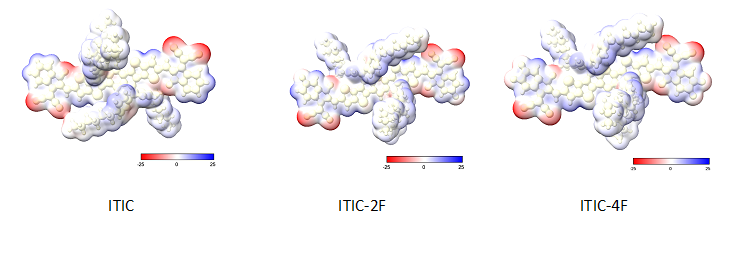
Fig. MEP mapped onto an electron density isosurface (ρ = 0.001 a.u.) for ITIC, ITIC-2F, and ITIC-4F molecules.