Speaker
Description
The graphene has become a widely investigated material since its controlled isolation and identification 20 years ago, and it started the boom of the two dimensional materials. The electronic, mechanical and other properties of graphene are affected by the native defects in it. Here we study the simple one, a mono-vacancy. A question about its mobility has been raised by the community of experimental groups performing imaging of graphene witht the Scanning Tunnelling Electron Microscopy (STEM), because they see
In order to give an answer to this question we performed molecular dynamics simulations of the graphene with a mono-vacancy at different temperatures, and from the rate of diffusion we estimate the hopping rate of the vacancy and thus the time of temporary stability at a given site. The potential we used is a machine learning interaction potential fitted to data from similar simulations with the density functional theory. The fitted potential allows us to run much longer simulations at a modest computing cost, with a system that is also larger than feasible with electronic structure calculations.
In this preliminary report of our results we compare our results with the earlier ones given in the literature.
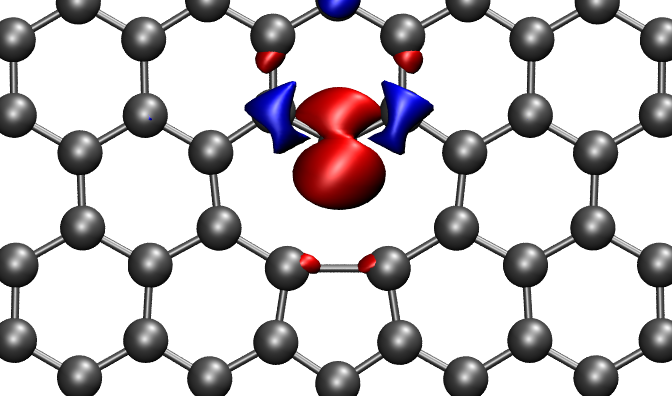
The spin electron density on the atoms around the vacancy in graphene from the DFT